

Honolulu Pickleball Paddles (2026): Full Lineup Reviewed
The J2CR has been our most-researched paddle for weeks and weeks, and Honolulu's naming system confuses almost everyone who shops it. Here's the whole lineup, measured, with a buy call for each shape.

No brand pays to be here or sees the page first.
I play every paddle at least 24 games before I rate it.
Same instruments, same ball, twelve swings per measurement.
Introduction
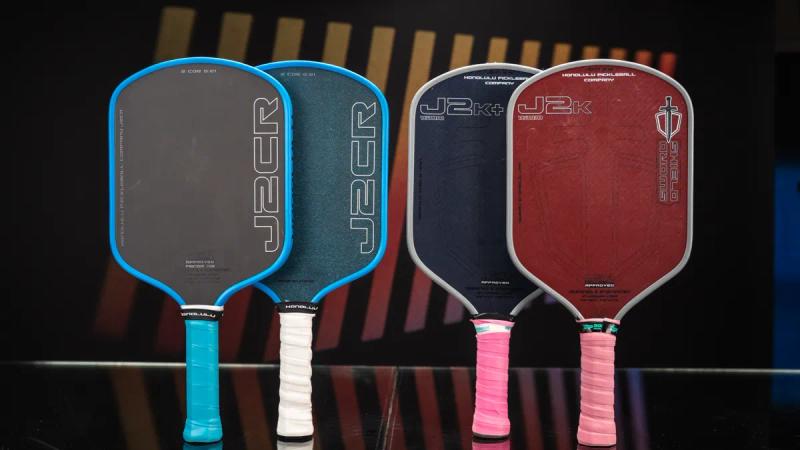
Honolulu's 2026 flagship is the Core Reactor line, a Gen 4 foam build at $195 across every shape. The J2CR hybrid is the one most players should buy, and it's been the single most-viewed paddle on this site for five straight weeks. Pick the shape first, then decide between the standard carbon face and the Crystal Blue grit, because that one choice changes both the spin number and where the paddle is tournament-legal. Not sure where you land, run the Paddle Finder.
Start Here: What the Names Actually Mean
The naming system is the single biggest reason people get stuck shopping this brand, so let's clear it before anything else.
The number is the shape.
J2 is the hybrid, a middle-length frame that's the most popular and the most forgiving.
J3 is the widebody (standard) shape.
J6 is the full elongated.
J7 is a newer elongated build.
So J2 versus J6 isn't a quality ladder; it's hybrid versus elongated. Same construction, different footprint.
The letters are the surface and core.
CR is Core Reactor, Honolulu's current Gen 4 foam build: a dual-density EPP and EVA foam core, molded as one piece, with a coarse peel-ply carbon face. NF is Notched Foam, an EVA foam core under a raw carbon face. FC+ is the fiberglass-carbon foam build. K is a DuPont Kevlar face, which trades spin for a softer, more muted pocket. Crystal Blue isn't a shape or a core, it's a surface: Honolulu's Endurance grit that replaces the carbon face on certain models.
Yes, it's confusing, but there's no questioning this brand's immense popularity.
Then a few suffixes. LH means long handle. H means fiberglass in the surface layup. Plus signs and extra letters (Ti, XK, NFK) are surface or material tweaks.
So the J2CR Crystal Blue LH reads as: hybrid shape, Core Reactor foam build, Crystal Blue grit surface, long handle. Once the pattern clicks, the catalog stops looking like a parts bin. If you haven't locked in a shape yet, how to choose a pickleball paddle covers that decision first.
One more thing before you buy, and it matters more than the name. The standard carbon J2CR and J6CR are approved by USA Pickleball. The Crystal Blue versions are UPA-A only. If you play USAP-sanctioned tournaments, the Crystal Blue is not legal there. Verify your event's sanctioning body before you spend the $195.
Why Honolulu Is Worth Paying Attention To
Start with the spin. The J2CR Crystal Blue measures 2471 RPM, which puts it on the spin leaderboard. The J6CR Crystal Blue sits right behind it at 2463. Surface roughness on both lands in the 97th and 98th percentile...top tier. Whatever Honolulu is doing with the Crystal Blue Endurance Surface, the grit numbers are real outliers.
Then the price. The Core Reactor line is $195 across every shape. The Gen 4 foam paddles it competes against from CRBN, Proton, and JOOLA range from $250 to $280. That's a $55 to $85 gap for comparable or better foam construction, and in several cases, the Honolulu outspins them.
The brand is Hawaiian and Christian-based, and it designs and engineers its paddles in Hawaii. The team comes out of aviation, firearms design, and engineering, and that firearms background is the origin of the Crystal Blue grit: the process started as pistol grip texture before it ever went on a paddle face. The catalog grew faster than the labeling system, which is why the lineup needs a decoder in the first place. None of that changes how the paddle plays. The measurements do, and the measurements are good.
The Honolulu Lineup at a Glance
Paddle | Shape | Spin | Swing | Price | Best For |
|---|---|---|---|---|---|
Hybrid | Above average | Light | $195 | Most players, fast hands | |
Hybrid | Elite | Very light | $195 | Max spin, non-USAP play | |
Elongated | Above average | Light | $195 | Reach and drive power | |
Elongated | Elite | Average | $195 | Elongated spin, non-USAP | |
Widebody | Above average | Light | $195 | Big sweet spot, pop | |
Hybrid | Near average | Light | $195 | Crisp foam feel, control | |
Hybrid | Above average | Very light | $195 | Spin plus dwell, touch | |
--- | --- | --- | --- | --- | --- |
Hybrid | Near average | Light | $155 | Budget control, Kevlar feel |
Use code MPB for 10% off at checkout. Spin and swing are translated from measured z-scores against every paddle I've tested, not raw guesses.
The Core Reactor Line ($195)
- 1. Honolulu Pickleball Co. J2CR 16mm — Serve speed 60.8 mph (radar-gun tested, 83rd percentile) · Spin 2288 rpm (camera-measured, 73rd percentile) · Twist weight 6.7 (67th percentile) · Static weight 8.1 oz (70th percentile) · Swing weight 111 (25th percentile) · Core 16 mm · Price $195
- 2. Honolulu Pickleball Co. J2CR Crystal Blue Long Handle 16mm — Serve speed 60.4 mph (radar-gun tested, 54th percentile) · Spin 2471 rpm (camera-measured, 98th percentile) · Twist weight 6.4 (48th percentile) · Static weight 8 oz (41st percentile) · Swing weight 108 (13th percentile) · Core 16 mm · Price $195
- 3. Honolulu Pickleball Co. J3CR 16mm — Serve speed 60.4 mph (radar-gun tested, 54th percentile) · Spin 2290 rpm (camera-measured, 76th percentile) · Twist weight 6.8 (76th percentile) · Static weight 8 oz (58th percentile) · Swing weight 110 (17th percentile) · Core 16 mm · Price $195
- 4. Honolulu Pickleball Co. J2CR LH 16mm — Serve speed 60.6 mph (radar-gun tested, 69th percentile) · Spin 2286 rpm (camera-measured, 70th percentile) · Twist weight 6.7 (67th percentile) · Static weight 8.1 oz (68th percentile) · Swing weight 111 (24th percentile) · Core 16 mm · Price $195
J6CR: The Elongated Build ($195)
- 1. Honolulu Pickleball Co. J6CR 16mm — Serve speed 61.2 mph (radar-gun tested, 97th percentile) · Spin 2296 rpm (camera-measured, 81st percentile) · Twist weight 6.2 (30th percentile) · Static weight 8 oz (50th percentile) · Swing weight 111 (28th percentile) · Core 16 mm · Price $195
- 2. Honolulu Pickleball Co. J6CR Crystal Blue 16mm — Serve speed 60.7 mph (radar-gun tested, 78th percentile) · Spin 2463 rpm (camera-measured, 98th percentile) · Twist weight 6.2 (30th percentile) · Static weight 8.1 oz (72nd percentile) · Swing weight 114 (51st percentile) · Core 16 mm · Price $195
Mid-Tier: J2NF and J2FC+ ($195)
- 1. Honolulu Pickleball Co. J2NF 16mm — Serve speed 60.4 mph (radar-gun tested, 54th percentile) · Spin 2270 rpm (camera-measured, 55th percentile) · Twist weight 6.9 (80th percentile) · Static weight 8 oz (56th percentile) · Swing weight 111 (28th percentile) · Core 16 mm · Price $195
- 2. Honolulu Pickleball Co. J2NF LH 16mm — Serve speed 60.5 mph (radar-gun tested, 61st percentile) · Spin 2217 rpm (camera-measured, 33rd percentile) · Twist weight 6.5 (57th percentile) · Static weight 8 oz (39th percentile) · Swing weight 108 (11th percentile) · Core 16 mm · Price $195
- 3. Honolulu Pickleball Co. J2FC+ 16mm — Serve speed 60.6 mph (radar-gun tested, 69th percentile) · Spin 2307 rpm (camera-measured, 87th percentile) · Twist weight 6.9 (79th percentile) · Static weight 8 oz (56th percentile) · Swing weight 108 (13th percentile) · Core 16 mm · Price $195
Budget Entry: J2K ($155)
- Honolulu Pickleball Co. J2K 16mm — Serve speed 59.7 mph (radar-gun tested, 31st percentile) · Spin 2198 rpm (camera-measured, 25th percentile) · Twist weight 6.7 (71st percentile) · Static weight 8.1 oz (70th percentile) · Swing weight 110 (21st percentile) · Core 16 mm · Price $155
Frequently asked questions
- J2CR or J6CR, which should I buy?
- Buy the J2CR unless you specifically want elongated reach. The J2CR is the hybrid: more forgiving, faster in hand, the better all-around paddle. The J6CR is the elongated version with elite serve speed and more drive leverage, but a smaller, less stable sweet spot. If your contact point wanders, the J2CR. If you hit clean and want reach and power, the J6CR.
- What is the Crystal Blue Endurance Surface, and is it USAP-approved?
- It's Honolulu's grit surface that replaces the standard carbon face. They don't print ink over the texture, which is why the surface looks intentionally imperfect, and the spin numbers back it up: 2471 RPM on the J2CR Crystal Blue , the highest I've measured. It is not USAP-approved. It's UPA-A only. If you play USA Pickleball sanctioned tournaments, this paddle isn't legal there, so buy the standard carbon J2CR instead.
- Standard handle or long handle, does it matter?
- The long handle adds reach and helps two-handed backhands, at the cost of a little hitting surface up top. If you hit a two-hander or you're coming from tennis, take the long handle. If you play mostly one-handed, the standard handle gives you slightly more face. It's a feel preference, not a performance gap.
- J2CR vs J2NF vs J2FC+, what's actually different?
- All three are $195 hybrids, but they feel like three different paddles. The J2CR is the current Gen 4 Core Reactor build, the fastest in hand and the most complete. The J2NF is crisp and direct, the foam paddle that feels most like a traditional carbon build. The J2FC+ is the plushest, with the most dwell and grip for touch and spin. Want one paddle, get the J2CR. Want a crisp feel, the J2NF. Want dwell and spin, the J2FC+.
- Does the J2CR need added weight?
- No. It plays well in stock form, and the appeal is how light and fast it already swings. If you want more stability on off-center hits, a small amount of weighted tape at the throat or the corners will add twist weight, but it isn't required to make the paddle playable.
- What's the break-in period like?
- Expect the face to feel firm for the first few hours, with the dink and reset game tightening up as it settles. Several players have described the first four to six hours as stiff before the touch shots come around. It's worth playing through rather than judging the paddle on day one.
- How does Honolulu compare to CRBN, Selkirk, and JOOLA at the same price?
- Honolulu undercuts all three. The Core Reactor line is $195 where comparable Gen 4 foam from CRBN and Proton runs $250 to $280, and the Honolulu matches or beats them on spin. You're paying less and giving up brand recognition, not measured performance. The one thing the bigger brands still win on is the deepest power builds, like the Perseus , which hit harder but spin far less.
- What does the naming system mean again?
- Number is the shape: J2 hybrid, J3 widebody, J6 elongated, J7 newer elongated. Letters are the surface and core: CR is the Core Reactor foam build, NF is Notched Foam, FC+ is fiberglass-carbon foam, K is Kevlar, and Crystal Blue is the high-spin grit surface. LH means long handle. That's the whole code.
- Which paddle on this list has the highest measured spin RPM?
- Honolulu Pickleball Co. J2CR Crystal Blue Long Handle 16mm — 2471 rpm, camera-measured on the same protocol as every other paddle I test.
- Which paddle on this list has the fastest measured serve speed?
- Honolulu Pickleball Co. J6CR 16mm — 61.2 mph, radar-gun tested.
- What is the cheapest paddle on this list?
- Honolulu Pickleball Co. J2K 16mm at $155.
The Core Reactor Line ($195)
Gen 4 | 16mm | Dual-density EPP/EVA foam | Coarse peel-ply carbon | $195
This is the lineup that matters in 2026. Core Reactor is a unibody molded-foam build, and what sets it apart from most foam cores at this price is how light it swings. Foam usually means dense, but not the case here. They sit light and head-light, and they play faster in hand than the spec sheet suggests, which is part of why they keep showing up on the best lightweight paddles list.
- Honolulu Pickleball Co. J2CR 16mm
Spin 2,288 RPM · Serve speed 60.8 mph · Weight 8.09 oz · Swing weight 110.7
Honolulu J2CR (Hybrid). This is the one most players should buy, and the data backs it. Serve speed lands at the 85th percentile, spin at the 81st, punch volley pop at the 75th, and the swing weight is below average for the category, so it moves quickly when hands get fast. The foam gives the contact a brief hold before the ball leaves, compared to honeycomb cores, so the power stays a little more predictable rather than jumping off the face. It's an all-court hybrid that happens to hit like a power paddle. If you want one Honolulu paddle and you play USAP events, this is it. → Buy the J2CR ($195)
- Honolulu Pickleball Co. J2CR Crystal Blue Long Handle 16mm
Spin 2,471 RPM · Serve speed 60.4 mph · Weight 7.96 oz · Swing weight 108.4
Honolulu J2CR Crystal Blue (Hybrid). Same frame, different face, different rulebook. The Crystal Blue Endurance Surface pushes spin to 2471 RPM, which puts it on the spin leaderboard, with surface roughness in the 97th percentile. It swings even lighter than the standard J2CR and sits head-light, so it plays nimble, not heavy. The trade-offs are two. Stability on off-center hits is moderate, so a miss toward the edge, and you will feel it. And it's UPA-A approved, not USAP, so it's off the table for USA Pickleball tournaments. For rec play, leagues, and UPA events where you want the most spin available, it's got top-tier spin output. I put both Crystal Blue shapes head-to-head in the J2CR vs J6CR Crystal Blue review. → Buy the J2CR Crystal Blue ($195)
- Honolulu Pickleball Co. J3CR 16mm
Spin 2,290 RPM · Serve speed 60.4 mph · Weight 8.04 oz · Swing weight 109.6
Honolulu J3CR (Widebody). The standard shape, wider face, shorter length. Punch volley pop jumps to the 96th percentile here, the highest of the Core Reactor builds, and the sweet spot is the most generous of the three. If you spend most of your time at the net and want a forgiving face with quick hands, the widebody is the call over the hybrid. Spin stays above average at 2290 RPM. → Buy the J3CR ($195)
- Honolulu Pickleball Co. J2CR LH 16mm
Spin 2,286 RPM · Serve speed 60.6 mph · Weight 8.08 oz · Swing weight 110.55
There's also a J2CR Long Handle if you prefer a longer handle for a twoie (two-handed backhand) and want more handle to work with. Same Core Reactor build, extended handle.
J6CR: The Elongated Build ($195)
Gen 4 | 16mm | Elongated | $195
One caveat is the sweet spot. Twist weight is below average, which means the elongated shape's already-smaller hitting zone gets less help from the frame on off-center contact. Reddit threads have flagged it against the Loco, and the measurement agrees: catch one toward the tip or the rail and you feel it. If you hit clean center contact, the J6CR gives you more reach and more drive than the hybrid. If you spray your contact point around, the J2CR hybrid shape is the more forgiving home. I broke the shape down in full in the J6CR review.
- Honolulu Pickleball Co. J6CR 16mm
Spin 2,296 RPM · Serve speed 61.2 mph · Weight 8 oz · Swing weight 111.35
The J6CR is the long-shape version of the same Core Reactor foam, and it's the second-most-searched paddle in the lineup for good reason. Serve speed is elite at the 98th percentile, the best of any Honolulu paddle I've tested, and spin stays above average at 2296 RPM. It still swings lighter than most elongated foam paddles, so you get the reach and the extra leverage on drives without the sluggish feel that usually comes with a long frame.
- Honolulu Pickleball Co. J6CR Crystal Blue 16mm
Spin 2,463 RPM · Serve speed 60.7 mph · Weight 8.1 oz · Swing weight 114.45
The J6CR Crystal Blue takes that same elongated frame and swaps in the Endurance grit for 2463 RPM. It sits at dead-average swing weight and a touch heavier in the hand than the carbon J6CR, so it plays like conventional elongated power-paddle territory with elite spin bolted on. Same UPA-A-only restriction applies. → Buy the J6CR ($195)
Mid-Tier: J2NF and J2FC+ ($195)
These are thermoformed foam paddles from the 2025 line, still in the catalog at $195, and they play differently enough from the Core Reactor builds to be a real choice rather than a discount.
- Honolulu Pickleball Co. J2NF 16mm
Spin 2,270 RPM · Serve speed 60.4 mph · Weight 8.03 oz · Swing weight 111.25
The J2NF (Notched Foam) is one of the crisper-feeling foam paddles I've played. The notched EVA core and raw carbon face give immediate, direct contact with no soft thud. Spin is near average at 2270 RPM and it scores high on control. If you've avoided foam cores because they feel mushy or slow, the J2NF is the one that feels closest to a traditional crisp build. It also carries the highest search volume of any term in this lineup, so plenty of players are already looking for exactly this feel. → Buy the J2NF ($195)
- Honolulu Pickleball Co. J2FC+ 16mm
Spin 2,307 RPM · Serve speed 60.6 mph · Weight 8.03 oz · Swing weight 108.3
The J2FC+ leans the other way. It's the plushest of the bunch, with a connected feel and the ball sinking briefly into the face before it releases. Spin shows up immediately at 2307 RPM, above average, and drives shape down hard. The swing weight is very light, in the 14th percentile, so it's quick in hand for how much grip it has on the ball, and it lands among the best lightweight paddles I've measured. Pop is moderate rather than explosive. This is the pick for a control player who wants spin and dwell over raw pace. → Buy the J2FC+ ($195)
Budget Entry: J2K ($155)
The Kevlar grips the ball, drives stay shaped, drops sit in the kitchen, and resets don't pop up on you. Spin is near average at 2198 RPM, which is strong for a Gen 2 build. It's the best entry point if you build points through placement instead of pace, and it earns its spot among the best paddles under $150. Use code MPB for 10% off. I covered it in full in the J2K review. → Buy the J2K ($155)
- Honolulu Pickleball Co. J2K 16mm
Spin 2,198 RPM · Serve speed 59.7 mph · Weight 8.09 oz · Swing weight 110.27
The J2K is the Gen 2 holdover that's still worth buying, a hybrid with a DuPont Kevlar face at $155. It's not built to overwhelm anyone, firepower sits well down the scale and pop is the lowest in this writeup. What it gives back is consistency.
How Honolulu Stacks Up Against the Field
Core Reactor hybrid against the premium foam field. The closest comps are the CRBN TruFoam Barrage 4 ($279.99) and the Vulcan Dark Matter Hybrid ($249.99). The CRBN is a 100% foam build with a 2304 RPM spin and a firepower score of 69; I reviewed it in full in the CRBN TruFoam Barrage review. The J2CR matches its spin, swings lighter, and costs $85 less. The Vulcan posts a higher firepower number but lower spin at 2279, and still runs $55 more. On construction, spin, and price together, the J2CR is the harder paddle to argue against.
Core Reactor elongated against the long-frame power paddles. Put the J6CR next to the Proton Series Three Peacock ($180) and the JOOLA Perseus Pro V 16mm ($299.99). The Proton is a unibody molded paddle with 2301 RPM and an 82 firepower score, a genuinely strong paddle, and Proton's markdowns now put it $15 under the J6CR. The Perseus hits harder, with an 89 firepower score, but its spin is well down at 2201 RPM, and it's a Gen 3 build, the same pattern across JOOLA's whole lineup. The J6CR splits the difference: elite serve speed, above-average spin, $195. The gap you're paying for on the JOOLA is brand and power, not spin.
Crystal Blue against the grittiest surfaces. The only paddle in the database that gets close on spin is the CRBN 2 TruFoam Waves ($279.99) at 2390 RPM, and the J2CR Crystal Blue still beats it by roughly 80 RPM at $85 less. The other brand building grit this aggressive is 11SIX24, and even that sits behind the Crystal Blue on raw RPM. Nothing I've measured out-spins it. The catch is always the same: it's UPA-A only.
J2K against the budget control field. At $155 it lines up with the PIKKL Hurricane Pro ($159.99) and the GRUVN MUVN-16HD ($169). Both of those out-spin the J2K, the PIKKL at 2320 and the GRUVN at 2290 with a full foam core. The J2K's edge is the Kevlar feel and the lower price. If spin is your priority at this budget, the GRUVN's foam build is the better number. If you want the muted Kevlar pocket, the J2K holds its spot. Either way, the best control paddles guide ranks the full field.
Who Each Paddle Is For
J2CR: The default recommendation. Tournament players, all-court players, and anyone who wants foam power without losing hand speed at the net. USAP-legal.
J2CR Crystal Blue: The spin maximizer. Aggressive players who live on rolls and topspin drives, who play rec or UPA-A events, and who hit center contact consistently enough to live with moderate forgiveness.
J3CR: The net player's pick. Widest face, biggest sweet spot, highest pop of the Core Reactor builds. Best for players who want a forgiving widebody with quick hands.
J6CR: The reach-and-drive option. Players who want elongated leverage and elite serve speed and who hit clean enough contact to handle a smaller sweet spot.
J6CR Crystal Blue: Elongated players who want the elite Crystal Blue spin and don't need USAP approval. Plays heavier and more neutral than the J2CR.
J2NF: The crisp-foam choice. Players who find most foam cores too soft and want direct, immediate feedback with high control.
J2FC+: The touch-and-spin pick. Control players who want dwell and grip over raw power, in a very light frame.
The Call
For most players the J2CR is the buy. It's USAP-legal and it's $195, which is $55 to $85 less than the foam paddles it matches on spin. The J2CR Crystal Blue measures more spin, but it's UPA-A only, so it's only an option if you don't play sanctioned USAP events. The J6CR is the pick if you want reach and drive and you hit clean contact. Stuck between the two Crystal Blue shapes, the J2CR vs J6CR Crystal Blue review breaks them down.
Buy through the links above with code MPB for 10% off, or run the Paddle Finder if you want to see how these stack against everything else I've tested. Still comparing brands? The full best pickleball paddles list has the whole field ranked.
Disclosure
Disclosure: Paddles in this post may have been provided by the brand at no cost. No money changed hands and no content was required in exchange. Affiliate links are used where noted. Purchases made through these links support this site at no additional cost to you.
Watch on YouTube: Honolulu Pickleball Paddles (2026): Full Lineup Reviewed
Watch on YouTube: Honolulu Pickleball Paddles (2026): Full Lineup Reviewed
Watch on YouTube: Honolulu Pickleball Paddles (2026): Full Lineup Reviewed
Watch on YouTube: Honolulu Pickleball Paddles (2026): Full Lineup Reviewed