

Best All-Court Pickleball Paddles, Tested and Measured
The best all-court pickleball paddles balance power, control, and forgiveness without forcing you into one extreme style of play. This guide explains what makes a paddle truly all-court and which types of paddles are the best fit for versatile players.

No brand pays to be here or sees the page first.
I play every paddle at least 24 games before I rate it.
Same instruments, same ball, twelve swings per measurement.
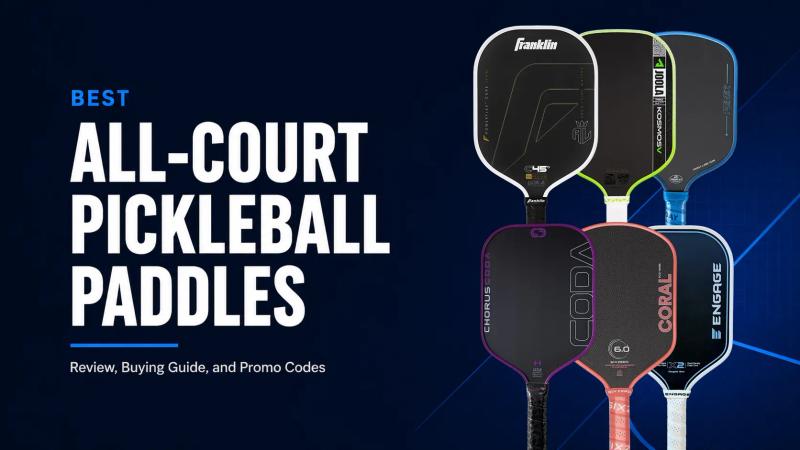
My picks
- 1.Six Zero Coral Hybrid$150Black FridayBlack Friday price, list $200
- 2.Engage X2$207.99code MPBwith code MPB, list $259.99
- 3.Chorus Coda$89.99Black FridayBlack Friday price, list $179.99
- 4.Honolulu J2NF LH$175.50code MPBwith code MPB, list $195
- 5.Franklin Anna Leigh Waters Signature C45 Aurelius 16mm$206.99Black FridayBlack Friday price, list $229.99
- 6.Friday Fever 16mm Standard$89.10code MPBwith code MPB, list $99
- 7.JOOLA Kosmos Pro V$299.95
- 8.Ronbus Quanta R4$79.99Black FridayBlack Friday price, list $119.99
- 9.Pickle Poppers POP N Pink$116.99Black FridayBlack Friday price, list $179.99
- 10.Ronbus Quanta R5$79.99Black FridayBlack Friday price, list $119
This is the all-court list. If you want the overall ranking across every shape and price, start with the best pickleball paddles page and come back here for the ones that do everything well.
Introduction
All-court pickleball paddles are built for players who want balance instead of extremes.
Some paddles are clearly made for raw power. Others lean heavily into control, touch, or spin. But most players don't actually want a paddle that only does one thing well. They want something versatile enough to handle drives, drops, resets, counters, and hand battles without constantly fighting the paddle.
That's where all-court paddles stand out.
At Matt's Pickleball, I test paddles using both on-court play and performance data including serve speed, punch volley speed, spin RPM, swing weight, twist weight, and overall playability. For an all-court paddle, I'm not looking for the single highest number in one category. What matters is whether it holds up across the widest range of shots and situations.
The best all-court paddles carry enough power to finish points and enough control to manage the soft game. They stay stable on a slight miss, and they fit a range of styles and skill levels.
Best All-Court Pickleball Paddles
- 1. Six Zero Pickleball Coral Hybrid 16mm — Serve speed 60.4 mph (radar-gun tested, 54th percentile) · Spin 2259 rpm (camera-measured, 48th percentile) · Twist weight 6.6 (61st percentile) · Static weight 8.1 oz (63rd percentile) · Swing weight 110 (22nd percentile) · Core 16 mm · Price $200
- 2. Engage X2 16mm — Serve speed 60.4 mph (radar-gun tested, 54th percentile) · Spin 2280 rpm (camera-measured, 63rd percentile) · Twist weight 6 (16th percentile) · Static weight 7.9 oz (26th percentile) · Swing weight 115 (60th percentile) · Core 16 mm · Price $260
- 3. Chorus Coda 16mm — Serve speed 60.5 mph (radar-gun tested, 61st percentile) · Spin 2252 rpm (camera-measured, 45th percentile) · Twist weight 6.8 (76th percentile) · Static weight 7.7 oz (8th percentile) · Swing weight 110 (21st percentile) · Core 16 mm · Price $180
- 4. Honolulu Pickleball Co. J2NF LH 16mm — Serve speed 60.5 mph (radar-gun tested, 61st percentile) · Spin 2217 rpm (camera-measured, 33rd percentile) · Twist weight 6.5 (57th percentile) · Static weight 8 oz (39th percentile) · Swing weight 108 (11th percentile) · Core 16 mm · Price $195
- 5. Franklin Anna Leigh Waters Signature C45 Aurelius 16mm — Serve speed 59.9 mph (radar-gun tested, 36th percentile) · Spin 2269 rpm (camera-measured, 54th percentile) · Twist weight 6.2 (30th percentile) · Static weight 7.6 oz (2nd percentile) · Swing weight 100 (1st percentile) · Core 16 mm · Price $230
- 6. Friday Pickleball Fever 16mm Standard — Serve speed 59.9 mph (radar-gun tested, 36th percentile) · Spin 2247 rpm (camera-measured, 43rd percentile) · Twist weight 7 (85th percentile) · Static weight 8.1 oz (72nd percentile) · Swing weight 113 (40th percentile) · Core 16 mm · Price $99
- 7. JOOLA Kosmos Pro V 16mm — Serve speed 60.4 mph (radar-gun tested, 54th percentile) · Spin 2283 rpm (camera-measured, 66th percentile) · Twist weight 6.8 (73rd percentile) · Static weight 8.1 oz (77th percentile) · Swing weight 115 (59th percentile) · Core 16 mm · Price $300
- 8. Ronbus Quanta R4 16mm — Serve speed 60.6 mph (radar-gun tested, 69th percentile) · Spin 2296 rpm (camera-measured, 81st percentile) · Twist weight 5.9 (8th percentile) · Static weight 7.7 oz (7th percentile) · Swing weight 104 (3rd percentile) · Core 16 mm · Price $120
- 9. Pickle Poppers POP N Pink 16mm — Serve speed 59.5 mph (radar-gun tested, 29th percentile) · Spin 2260 rpm (camera-measured, 49th percentile) · Twist weight 6.5 (54th percentile) · Static weight 7.6 oz (1st percentile) · Swing weight 96 (0th percentile) · Core 16 mm · Price $180
- 10. Ronbus Quanta R5 16mm — Serve speed 60.5 mph (radar-gun tested, 61st percentile) · Spin 2311 rpm (camera-measured, 88th percentile) · Twist weight 6.1 (24th percentile) · Static weight 7.6 oz (2nd percentile) · Swing weight 103 (2nd percentile) · Core 16 mm · Price $119
- 11. Franklin Anna Leigh Waters Signature C45 Aurelius 14mm — Serve speed 59.8 mph (radar-gun tested, 33rd percentile) · Spin 2255 rpm (camera-measured, 46th percentile) · Twist weight 6.2 (30th percentile) · Static weight 7.5 oz (1st percentile) · Swing weight 100 (1st percentile) · Core 14 mm · Price $230
- 12. Franklin C45 Hayden Patriquin 16mm — Serve speed 60.1 mph (radar-gun tested, 42nd percentile) · Spin 2245 rpm (camera-measured, 43rd percentile) · Twist weight 6 (16th percentile) · Static weight 7.9 oz (28th percentile) · Swing weight 116 (61st percentile) · Core 16 mm · Price $230
- 13. Honolulu Pickleball Co. J6FC+ 16mm — Serve speed 60.2 mph (radar-gun tested, 45th percentile) · Spin 2291 rpm (camera-measured, 78th percentile) · Twist weight 6.7 (71st percentile) · Static weight 8.1 oz (78th percentile) · Swing weight 118 (79th percentile) · Core 16 mm · Price $195
- 14. Vatic Pro V-Sol Power Bloom 16mm — Serve speed 60.3 mph (radar-gun tested, 50th percentile) · Spin 2202 rpm (camera-measured, 28th percentile) · Twist weight 7.1 (87th percentile) · Static weight 8.1 oz (74th percentile) · Swing weight 110 (18th percentile) · Core 16 mm · Price $80
- 15. Engage Pursuit Alpha Pro 16mm — Serve speed 60.5 mph (radar-gun tested, 61st percentile) · Spin 2278 rpm (camera-measured, 60th percentile) · Twist weight 6.1 (24th percentile) · Static weight 8.1 oz (72nd percentile) · Swing weight 111 (28th percentile) · Core 16 mm · Price $260
- 16. Vatic Pro V-Sol Power V7 16mm — Serve speed 60.3 mph (radar-gun tested, 50th percentile) · Spin 2255 rpm (camera-measured, 46th percentile) · Twist weight 6.7 (67th percentile) · Static weight 8.2 oz (84th percentile) · Swing weight 114 (46th percentile) · Core 16 mm · Price $80
- 17. Vatic Pro V-Sol Power Flash 16mm — Serve speed 60.4 mph (radar-gun tested, 54th percentile) · Spin 2277 rpm (camera-measured, 59th percentile) · Twist weight 6.6 (61st percentile) · Static weight 8.1 oz (70th percentile) · Swing weight 109 (14th percentile) · Core 16 mm · Price $80
- 18. Pickleball Apes Charm V 16mm — Serve speed 60.4 mph (radar-gun tested, 54th percentile) · Spin 2281 rpm (camera-measured, 64th percentile) · Twist weight 7.5 (97th percentile) · Static weight 8.2 oz (89th percentile) · Swing weight 112 (31st percentile) · Core 16 mm · Price $130
- 19. Ronbus Refoam R4 14mm — Serve speed 60.3 mph (radar-gun tested, 50th percentile) · Spin 2243 rpm (camera-measured, 42nd percentile) · Twist weight 6.5 (54th percentile) · Static weight 7.9 oz (28th percentile) · Swing weight 111 (27th percentile) · Core 14 mm · Price $100
- 20. Six Zero Pickleball Coral Pro Elongated 16mm — Serve speed 60.5 mph (radar-gun tested, 61st percentile) · Spin 2483 rpm (camera-measured, 99th percentile) · Twist weight 6 (16th percentile) · Static weight 8 oz (52nd percentile) · Swing weight 114 (50th percentile) · Core 16 mm · Price $220
- 21. Six Zero Pickleball Coral Pro Hybrid 16mm — Serve speed 60.4 mph (radar-gun tested, 54th percentile) · Spin 2481 rpm (camera-measured, 99th percentile) · Twist weight 6.7 (67th percentile) · Static weight 8.1 oz (74th percentile) · Swing weight 112 (30th percentile) · Core 16 mm · Price $220
- 22. Six Zero Pickleball Coral Pro Widebody 16mm — Serve speed 60.2 mph (radar-gun tested, 45th percentile) · Spin 2485 rpm (camera-measured, 100th percentile) · Twist weight 7.3 (93rd percentile) · Static weight 8.2 oz (89th percentile) · Swing weight 109 (14th percentile) · Core 16 mm · Price $220
Frequently asked questions
- What is an all-court pickleball paddle?
- An all-court pickleball paddle is a paddle that balances power, control, spin, and forgiveness instead of focusing too heavily on one trait. It is designed to perform well across a wide range of shots and situations.
- Are all-court paddles good for beginners?
- They can be, especially for players who want a paddle they can grow with. A forgiving all-court paddle is often a better long-term choice than a very specialized power paddle.
- Are all-court paddles better than power paddles?
- Not necessarily. They are just more balanced. Power paddles may be better for players who want maximum pace, while all-court paddles tend to be better for versatility and broader usability.
- What shape is best for an all-court paddle?
- Hybrid and standard shapes are often strong fits because they balance reach, forgiveness, and maneuverability. That said, elongated paddles can still work well if they remain stable and manageable.
- Do all-court paddles have enough power?
- Yes, the good ones do. They may not be the most explosive paddles on the market, but they should still give you enough offense to attack and finish points.
- Who should use an all-court paddle?
- Players who want versatility, adaptability, and balance are usually the best fit. This includes many intermediate players, doubles players, and advanced players who do not want an overly specialized paddle.
- Which paddle on this list has the highest measured spin RPM?
- Six Zero Pickleball Coral Pro Widebody 16mm — 2485 rpm, camera-measured on the same protocol as every other paddle I test.
- Which paddle on this list has the fastest measured serve speed?
- Ronbus Quanta R4 16mm — 60.6 mph, radar-gun tested.
- What is the cheapest paddle on this list?
- Vatic Pro V-Sol Power Bloom 16mm at $80.
Best All-Court Pickleball Paddles
- Six Zero Pickleball Coral Hybrid 16mm
Spin 2,259 RPM · Serve speed 60.4 mph · Weight 8.06 oz · Swing weight 110.4
The Coral Hybrid 16mm prioritizes placement and fast hands. Its low 110.4 SW means you'll win those quick exchanges at the net. An above-average 6.55 TW keeps mishits stable, letting you hit your spots with confidence. It's a control player's dream, not a power hitter's. Read the full review →
- Chorus Coda 16mm
Spin 2,252 RPM · Serve speed 60.5 mph · Weight 7.74 oz · Swing weight 110.2
Need control without going full soft-paddle? The Coda 16mm balances a 64 FP with an above-average 6.8 TW. Sure, 7.74oz with a 110.2 SW won't overwhelm, but it's consistent. This one's for players who value precision and stability over raw pop. Read the full review →
- Honolulu Pickleball Co. J2NF LH 16mm
Spin 2,217 RPM · Serve speed 60.5 mph · Weight 7.95 oz · Swing weight 107.8
That 6.5 TW is nice for a paddle with only 67 FP, making it surprisingly stable on resets. At 7.95oz, it’s not super light, but the 107.8 SW helps it play faster than expected. This paddle won’t blow anyone away with power, but for control players who need some defensive stability, it’s a good option. View full specs →
- Franklin Anna Leigh Waters Signature C45 Aurelius 16mm
Spin 2,269 RPM · Serve speed 59.9 mph · Weight 7.62 oz · Swing weight 99.6
A quick 99.6 SW at 7.62oz makes the Anna Leigh Waters Signature C45 Aurelius 16mm feel fast in hand. Its 57 FP rating means it's not a power paddle, but the 6.2 TW gives it surprising stability for its weight. This paddle prioritizes control and maneuverability. Read the full review →
- Friday Pickleball Fever 16mm Standard
Spin 2,247 RPM · Serve speed 59.9 mph · Weight 8.1 oz · Swing weight 112.9
A true middle-of-the-road option, the Fever 16mm Standard is solid everywhere and elite nowhere. At 8.10oz with a 112.9 SW and 7 TW, it's a stable paddle with a respectable 67 FP. You get raw carbon spin and enough control (4 CR) for touch shots. If you want a dependable all-rounder for under $100, here it is. View full specs →
- JOOLA Kosmos Pro V 16mm
Spin 2,283 RPM · Serve speed 60.4 mph · Weight 8.13 oz · Swing weight 115.35
A true feel player's paddle with a 6.75 TW and a balanced 115.35 SW. The Kosmos Pro V 16mm gives you predictable stability for resets and dinks, though the 67 FP means you'll provide most of the power. This paddle gives consistent responses across all situations. View full specs →
- Ronbus Quanta R4 16mm
Spin 2,296 RPM · Serve speed 60.6 mph · Weight 7.71 oz · Swing weight 103.85
The Ronbus Quanta R4 16mm hits punch volleys at 38.9 MPH — 89th percentile. At 7.71oz and 103.85 SW, it’s light and fast, especially for a hybrid shape. It feels stiff stock but add some lead tape, and it becomes a balanced shot-maker. Anyone looking for an affordable, generalist paddle should try it. Read the full review →
- Pickle Poppers POP N Pink 16mm
Spin 2,260 RPM · Serve speed 59.5 mph · Weight 7.56 oz · Swing weight 96.1
Don't let the name fool you, this paddle plays seriously. The POP N Pink 16mm hits with 63 FP and a surprising 96.1 SW, great for all-court play. It's solid without being heavy, at 7.56oz. This one is for players who want a balanced paddle that can do a bit of everything without overcommitting in any single area. Read the full review →
- Ronbus Quanta R5 16mm
Spin 2,311 RPM · Serve speed 60.5 mph · Weight 7.61 oz · Swing weight 103.45
Lowest Firepower (67) in the Ronbus Quanta line, but still a speedy attacker at 7.61oz and 103.45 SW. Its 6.08 TW means it plays a bit harsh off-center stock. This paddle transforms with some lead tape, giving you a budget sleeper for under $120. Read the full review →
- Franklin Anna Leigh Waters Signature C45 Aurelius 14mm
Spin 2,255 RPM · Serve speed 59.8 mph · Weight 7.54 oz · Swing weight 99.5
56 Firepower at 7.54oz means this paddle packs a punch for its weight. The Anna Leigh Waters Signature C45 Aurelius 14mm feels quick in hand at 99.5 SW, making it responsive for fast exchanges. It's a modern Gen 3 build with good overall pop and control. Read the full review →
- Franklin C45 Hayden Patriquin 16mm
Spin 2,245 RPM · Serve speed 60.1 mph · Weight 7.89 oz · Swing weight 115.55
An absolute nuke if you can swing it. The C45 Hayden Patriquin 16mm hits with 57 FP but carries a heavy 115.55 SW. That static weight of 7.89oz and 6.0 TW keep it stable. For strong players who want to drive with extreme force, this paddle hits HARD. Read the full review →
- Honolulu Pickleball Co. J6FC+ 16mm
Spin 2,291 RPM · Serve speed 60.2 mph · Weight 8.14 oz · Swing weight 118.3
Don't let the 44 FP fool you — this paddle prioritizes feel. At 118.3 SW and 8.14oz, the J6FC+ 16mm has serious mass behind it, making it one of the most stable paddles in its class. Control suffers a bit (3 CR), but the peel ply surface still bites. If you want a heavy, stable offensive weapon, this is it. Read the full review →
- Vatic Pro V-Sol Power Bloom 16mm
Spin 2,202 RPM · Serve speed 60.3 mph · Weight 8.11 oz · Swing weight 109.65
Don't let the "Power" in the name fool you; this paddle prioritizes feel. Its 50 FP is low, but the 7.1 TW for an 8.11oz paddle helps deliver nice stability. It's a control-oriented choice at a killer price, great for players who want to place shots. You give up some pop, but gain a lot of consistency. Read the full review →
- Engage Pursuit Alpha Pro 16mm
Spin 2,278 RPM · Serve speed 60.5 mph · Weight 8.1 oz · Swing weight 111.25
This paddle is a quick, reliable weapon. The Pursuit Alpha Pro 16mm hits with 67 FP, but the 111.25 SW makes it faster on resets than most elongated frames. At 8.10oz with a 6.1 TW, it's forgiving when things get hectic. Think Gen 3 performance without the wildness. View full specs →
- Vatic Pro V-Sol Power V7 16mm
Spin 2,255 RPM · Serve speed 60.3 mph · Weight 8.19 oz · Swing weight 113.8
Still the best $100 paddle you can buy. The Vatic Pro V-Sol Power V7 gives you 58 FP and a solid 113.8 SW at 8.19oz. That foam perimeter just helps it feel more stable than it should. You get a lot of paddle for the cash here. Read the full review →
- Vatic Pro V-Sol Power Flash 16mm
Spin 2,277 RPM · Serve speed 60.4 mph · Weight 8.09 oz · Swing weight 108.7
Low FP but surprisingly powerful. The Vatic Pro V-Sol Power Flash swings heavy at 108.7 SW and a static 8.09oz, giving it a solid feel through the ball. Its lower 48 FP keeps drives honest, making you swing out more often. This is a budget power paddle for players who control their own pace. Read the full review →
- Pickleball Apes Charm V 16mm
Spin 2,281 RPM · Serve speed 60.4 mph · Weight 8.22 oz · Swing weight 111.8
Heavy and forgiving, the Charm V 16mm feels plush at contact. Its 7.5 TW handles mis-hits like a champ, but that deep flex in the core means a 56 FP and touch shots that lack precision. This paddle forgives everything — maybe too much. Best for players who prioritize stability over crisp feedback. View full specs →
- Ronbus Refoam R4 14mm
Spin 2,243 RPM · Serve speed 60.3 mph · Weight 7.89 oz · Swing weight 111.15
Talk about a stable paddle! The Ronbus Refoam R4 14mm clocks a 6.45 TW and a 111.15 SW with foam injected edges. It's balanced and forgiving on off-center hits. Your tradeoff? Just a 59 FP — so don't expect to overpower opponents. This paddle gives you control and a buttery soft feel. Read the full review →
- Six Zero Pickleball Coral Pro Elongated 16mm
Spin 2,483 RPM · Serve speed 60.5 mph · Weight 8.01 oz · Swing weight 114.3
For players who want reach and put-away power. The Six Zero Coral Pro Elongated 16mm swings the heaviest at 114.3 SW with 65 FP, so you get extra leverage from the baseline and at the kitchen line. Your tradeoff? A lower 6.0 TW and a tighter sweet spot mean it's less forgiving on off-center hits. If you make consistent contact, the longer shape rewards you with reach most paddles can't match. Read the full review →
- Six Zero Pickleball Coral Pro Hybrid 16mm
Spin 2,481 RPM · Serve speed 60.4 mph · Weight 8.11 oz · Swing weight 111.65
The do-everything pick? The Six Zero Coral Pro Hybrid 16mm sits right in the middle with a 111.65 SW, a 6.65 TW, and 65 FP. The hybrid shape splits the difference between reach and maneuverability, so nothing feels like a weakness. The tradeoff? A paddle built for pure power or pure control will beat it in that one area. Spin holds up too at 2,481 RPM. Read the full review →
- Six Zero Pickleball Coral Pro Widebody 16mm
Spin 2,485 RPM · Serve speed 60.2 mph · Weight 8.22 oz · Swing weight 108.75
The most forgiving of the three. The Six Zero Coral Pro Widebody 16mm pairs a quick 108.75 SW with a stable 7.25 TW, so it's fast at the net and forgiving when you catch one off-center. It also brings the most pop of the group at 66 FP. The tradeoff? The standard widebody build gives up some reach compared to the other two. Stable, quick, and easy to play. Read the full review →
What Is an All-Court Pickleball Paddle?
An all-court pickleball paddle balances multiple performance areas instead of specializing too heavily in one. That usually means sitting somewhere in the middle of the power-control spectrum, enough pop and pace to stay aggressive when needed, but predictable enough on resets, dinks, drops, and blocks.
In practical terms, a good all-court paddle should feel usable in every phase of the game: baseline drives, transition resets, kitchen exchanges, counters, and serves.
What Makes a Paddle Truly All-Court?
A paddle doesn't become all-court just because a brand says so.
Balanced power and control. It shouldn't be dead, but it shouldn't be wild either. You should be able to attack with it without losing trust in your touch game.
Manageable swing feel. A paddle can have great performance on paper and still feel too demanding over the course of a full match. All-court paddles usually avoid extreme swing weight profiles.
Forgiveness. If a paddle only feels good on perfect contact, it's probably too specialized. All-court paddles need enough stability to hold up on slight misses.
Usable spin. Spin matters, but all-court paddles don't need to chase the highest RPM possible. They need enough grip and dwell time to shape shots effectively.
Versatility across shot types. A paddle that's great on drives but weak in the soft game isn't truly all-court. Neither is a paddle that resets beautifully but struggles to create offense.
Why All-Court Paddles Are a Smart Choice for Most Players
For most players, especially intermediates and improving advanced players, all-court paddles are one of the smartest categories to shop.
That's because most players are still evolving. If you buy a paddle that's too specialized too early, you can end up limiting yourself or getting outplayed in the phase of the game your paddle isn't designed for.
A well-balanced all-court paddle gives you room to develop offense and improve touch while you experiment with different styles, and it keeps you competitive in more situations.
All-Court vs Power vs Control Paddles
Power paddles are built around putaway speed, pop, and pace. The tradeoff is often less forgiveness or a more demanding feel on soft shots. Control paddles go the other way, toward touch, resets, and predictability, and they give up finishing power for it. All-court paddles try to sit between those extremes. They may not lead the market in one isolated category, but they're often better over the course of a full match because they can handle more situations well.
Shape and Construction Still Matter
Even within the all-court category, not every paddle will feel the same. Hybrid and standard shapes often make a lot of sense here because they balance reach, forgiveness, and maneuverability. Modern thermoformed paddles, foam-enhanced designs, and foam-core builds have widened the all-court category considerably. Some of today's paddles can deliver real offensive performance without giving up too much control, which makes this category deeper than it used to be.