

Best Widebody Pickleball Paddles (2026)
Standard and widebody pickleball paddles offer the largest sweet spots and easiest handling. Learn why these shapes work for most players and how to choose the right one.

No brand pays to be here or sees the page first.
I play every paddle at least 24 games before I rate it.
Same instruments, same ball, twelve swings per measurement.
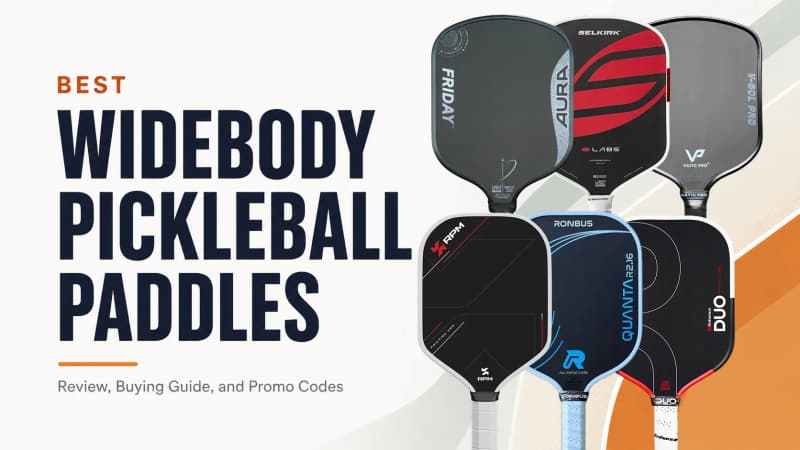
My picks
- 1.RPM Friction Pro Widebody 16mm$212.49code MPBwith code MPB, list $249.99
- 2.Enhance DUO Widebody$174.99Black FridayBlack Friday price, list $199.99
- 3.Ronbus Quanta R2$79.99Black FridayBlack Friday price, list $119.99
- 4.RPM Q2 Widebody 16mm$212.49code MPBwith code MPB, list $249.99
- 5.RPM Friction Pro Widebody 14mm$212.49code MPBwith code MPB, list $249.99
- 6.Bread & Butter Loco Standard$179.10code MPBwith code MPB, list $199
- 7.Friday Fever 102 Standard$91.80code MPBwith code MPB, list $102
- 8.Friday Aura Widebody$116.10code MPBwith code MPB, list $129
- 9.Selkirk Boomstik Widebody$249.99Black FridayBlack Friday price, list $333
- 10.Vatic Pro V-Sol Pro Bloom$99.99code MPBwith code MPB, list $109.99
This page is widebody shapes only. The overall ranking is on the best pickleball paddles page.
Introduction
Widebody pickleball paddles trade length for width. Some reviewers call the widebody a standard shape, same paddle. The shorter, wider face buys you a bigger sweet spot and steadier contact across the face.
For players still developing their game, that's usually the right trade. Longer shapes get the attention because pros swing them, but the widebody is one of the most practical shapes in the game.
This guide covers what defines a widebody, how the shape plays, and how to decide whether it fits how you play.
Best Widebody Pickleball Paddles
- 1. RPM Pickleball Friction Pro Widebody 16mm — Serve speed 60.8 mph (radar-gun tested, 83rd percentile) · Spin 2303 rpm (camera-measured, 85th percentile) · Twist weight 7.4 (95th percentile) · Static weight 8 oz (56th percentile) · Swing weight 112 (33rd percentile) · Core 16 mm · Price $250
- 2. Enhance Pickleball DUO Widebody 16mm — Serve speed 60.1 mph (radar-gun tested, 42nd percentile) · Spin 2285 rpm (camera-measured, 69th percentile) · Twist weight 7.3 (93rd percentile) · Static weight 8 oz (52nd percentile) · Swing weight 112 (30th percentile) · Core 16 mm · Price $200
- 3. Ronbus Quanta R2 16mm — Serve speed 60.4 mph (radar-gun tested, 54th percentile) · Spin 2216 rpm (camera-measured, 33rd percentile) · Twist weight 6.4 (48th percentile) · Static weight 7.7 oz (4th percentile) · Swing weight 102 (2nd percentile) · Core 16 mm · Price $120
- 4. RPM Pickleball Q2 Widebody 16mm — Serve speed 61.1 mph (radar-gun tested, 95th percentile) · Spin 2310 rpm (camera-measured, 87th percentile) · Twist weight 6.9 (79th percentile) · Static weight 7.9 oz (23rd percentile) · Swing weight 107 (9th percentile) · Core 16 mm · Price $250
- 5. RPM Pickleball Friction Pro Widebody 14mm — Serve speed 60.6 mph (radar-gun tested, 69th percentile) · Spin 2281 rpm (camera-measured, 64th percentile) · Twist weight 7 (83rd percentile) · Static weight 7.9 oz (23rd percentile) · Swing weight 108 (13th percentile) · Core 16 mm · Price $250
- 6. Bread & Butter Loco Standard 16mm — Serve speed 60.6 mph (radar-gun tested, 69th percentile) · Spin 2285 rpm (camera-measured, 69th percentile) · Twist weight 7.3 (94th percentile) · Static weight 8.1 oz (74th percentile) · Swing weight 110 (19th percentile) · Core 16 mm · Price $199
- 7. Friday Pickleball Fever 102 Standard 16mm — Serve speed 59.8 mph (radar-gun tested, 33rd percentile) · Spin 2157 rpm (camera-measured, 15th percentile) · Twist weight 7.1 (87th percentile) · Static weight 8 oz (56th percentile) · Swing weight 111 (24th percentile) · Core 16 mm · Price $102
- 8. Friday Pickleball Aura Widebody 16mm — Serve speed 60.8 mph (radar-gun tested, 83rd percentile) · Spin 2289 rpm (camera-measured, 74th percentile) · Twist weight 6.6 (64th percentile) · Static weight 7.9 oz (23rd percentile) · Swing weight 107 (6th percentile) · Core 16 mm · Price $129
- 9. Selkirk Boomstik Widebody 16mm — Serve speed 60.7 mph (radar-gun tested, 78th percentile) · Spin 2188 rpm (camera-measured, 21st percentile) · Twist weight 7.8 (99th percentile) · Static weight 8.7 oz (99th percentile) · Swing weight 113 (43rd percentile) · Core 16 mm · Price $333
- 10. Vatic Pro V-Sol Pro Bloom 16mm — Serve speed 60.5 mph (radar-gun tested, 61st percentile) · Spin 2215 rpm (camera-measured, 32nd percentile) · Twist weight 7.1 (87th percentile) · Static weight 8.1 oz (74th percentile) · Swing weight 111 (28th percentile) · Core 16 mm · Price $110
- 11. RPM Pickleball Q2 Widebody 14mm — Serve speed 60.9 mph (radar-gun tested, 88th percentile) · Spin 2289 rpm (camera-measured, 74th percentile) · Twist weight 6.8 (73rd percentile) · Static weight 7.7 oz (7th percentile) · Swing weight 105 (3rd percentile) · Core 16 mm · Price $250
- 12. Franklin Anna Leigh Waters Signature C45 Aurelius 16mm — Serve speed 59.9 mph (radar-gun tested, 36th percentile) · Spin 2269 rpm (camera-measured, 54th percentile) · Twist weight 6.2 (30th percentile) · Static weight 7.6 oz (2nd percentile) · Swing weight 100 (1st percentile) · Core 16 mm · Price $230
- 13. Ronbus Quanta R5 16mm — Serve speed 60.5 mph (radar-gun tested, 61st percentile) · Spin 2311 rpm (camera-measured, 88th percentile) · Twist weight 6.1 (24th percentile) · Static weight 7.6 oz (2nd percentile) · Swing weight 103 (2nd percentile) · Core 16 mm · Price $119
- 14. Honolulu Pickleball Co. J3NF 16mm — Serve speed 60.1 mph (radar-gun tested, 42nd percentile) · Spin 2230 rpm (camera-measured, 38th percentile) · Twist weight 6.7 (67th percentile) · Static weight 8 oz (44th percentile) · Swing weight 110 (18th percentile) · Core 16 mm · Price $195
- 15. Friday Pickleball Fever 16mm Standard — Serve speed 59.9 mph (radar-gun tested, 36th percentile) · Spin 2247 rpm (camera-measured, 43rd percentile) · Twist weight 7 (85th percentile) · Static weight 8.1 oz (72nd percentile) · Swing weight 113 (40th percentile) · Core 16 mm · Price $99
- 16. Franklin Anna Leigh Waters Signature C45 Aurelius 14mm — Serve speed 59.8 mph (radar-gun tested, 33rd percentile) · Spin 2255 rpm (camera-measured, 46th percentile) · Twist weight 6.2 (30th percentile) · Static weight 7.5 oz (1st percentile) · Swing weight 100 (1st percentile) · Core 14 mm · Price $230
- 17. Vulcan Pickleball White Noise Widebody 16mm — Serve speed 60.4 mph (radar-gun tested, 54th percentile) · Spin 2290 rpm (camera-measured, 76th percentile) · Twist weight 6.6 (61st percentile) · Static weight 7.8 oz (10th percentile) · Swing weight 109 (14th percentile) · Core 16 mm · Price $250
- 18. Volair SHIFT WB 14mm — Serve speed 60.4 mph (radar-gun tested, 54th percentile) · Spin 2289 rpm (camera-measured, 74th percentile) · Twist weight 7.2 (91st percentile) · Static weight 8.1 oz (72nd percentile) · Swing weight 106 (5th percentile) · Core 14 mm · Price $120
- 19. Franklin Anna Leigh Waters Signature C45 Aurelius 12.7mm — Serve speed 59.6 mph (radar-gun tested, 29th percentile) · Spin 2240 rpm (camera-measured, 41st percentile) · Twist weight 5.7 (3rd percentile) · Static weight 7.3 oz (0th percentile) · Swing weight 93 (0th percentile) · Core 13 mm · Price $230
Frequently asked questions
- What is a widebody pickleball paddle?
- A widebody paddle is shorter and wider than elongated shapes, typically around 16 inches long and 8 inches wide. This design increases sweet spot size and improves forgiveness.
- Are widebody paddles better for beginners?
- Yes. Their larger sweet spots and easier maneuverability make them one of the most accessible paddle shapes for new players.
- Do widebody paddles have less power?
- They can offer slightly less leverage on full swings, but modern construction methods allow widebody paddles to generate significant power.
- Are widebody paddles good for control?
- Many widebody paddles feel more stable and predictable, which can improve consistency and shot placement.
- Who should avoid widebody paddles?
- Players who rely heavily on reach or aggressive baseline drives may prefer hybrid or elongated shapes.
- Can advanced players use widebody paddles?
- Yes. Many advanced players choose widebody designs for hand speed, consistency, and stability in fast exchanges.
- Which paddle on this list has the highest measured spin RPM?
- Ronbus Quanta R5 16mm — 2311 rpm, camera-measured on the same protocol as every other paddle I test.
- Which paddle on this list has the fastest measured serve speed?
- RPM Pickleball Q2 Widebody 16mm — 61.1 mph, radar-gun tested.
- What is the cheapest paddle on this list?
- Friday Pickleball Fever 16mm Standard at $99.
Best Widebody Pickleball Paddles
The top-performing standard and widebody paddles in the database — selected for stability, sweet spot size, and overall balance across offense and defense.- RPM Pickleball Friction Pro Widebody 16mm
Spin 2,303 RPM · Serve speed 60.8 mph · Weight 8.03 oz · Swing weight 112.05
Here's a Gen 3 power paddle that won't punish touch shots. The Friction Pro Widebody 16mm hits hard (94 FP) but has a linear power band, so you get output without extreme trampoline effect. At 8.03oz with a 112.05 SW and 7.35 TW, it's seriously stable for its weight. Read the full review →
- Enhance Pickleball DUO Widebody 16mm
Spin 2,285 RPM · Serve speed 60.1 mph · Weight 8.01 oz · Swing weight 111.65
70 Firepower and a 7.25 TW make the DUO Widebody 16mm a stable power player. Hits feel dense, not hollow. At 8.01oz and 111.65 SW, it's got real weight behind it without feeling sluggish. This paddle hits heavy and provides surprising forgiveness. View full specs →
- Ronbus Quanta R2 16mm
Spin 2,216 RPM · Serve speed 60.4 mph · Weight 7.67 oz · Swing weight 102.2
The lowest swing weight (102.2 SW) in its class means the Quanta R2 16mm flies through exchanges. Out of the box, the 6.4 TW makes the sweet spot feel small. Add lead tape and this thing punches above its weight with 69 FP and easy spin. Read the full review →
- RPM Pickleball Q2 Widebody 16mm
Spin 2,310 RPM · Serve speed 61.1 mph · Weight 7.87 oz · Swing weight 107.4
Don't let the 94 FP fool you; the RPM Q2 plays like a Gen 3 workhorse, not a typical dampened foam paddle. At 7.87oz with a 107.4 SW, it feels nimble enough to get around. This one gives you elite power and real feedback, not just a muted thwack. Finally, a foam core that plays honest. Read the full review →
- RPM Pickleball Friction Pro Widebody 14mm
Spin 2,281 RPM · Serve speed 60.6 mph · Weight 7.87 oz · Swing weight 108.35
This 14mm widebody excels in fast hands battles with a 108.35 SW and 6.95 TW. That's lightning quick without sacrificing stability. It plays surprisingly powerful for its profile, too, hitting 93 FP. Great for players who want to dominate the kitchen and quick counters. Read the full review →
- Bread & Butter Loco Standard 16mm
Spin 2,285 RPM · Serve speed 60.6 mph · Weight 8.11 oz · Swing weight 109.9
Most forgiving on this list, the Loco Standard 16mm hits a 7.3 TW with a manageable 109.9 SW. At 8.11oz, it feels quick through the air without sacrificing stability. It's built for fast hands and consistent power, even on off-center hits. Read the full review →
- Friday Pickleball Fever 102 Standard 16mm
Spin 2,157 RPM · Serve speed 59.8 mph · Weight 8.03 oz · Swing weight 110.6
At 8.03oz with a 110.6 SW, the Fever 102 Standard leans into stability and mass for a controlled feel. Its 68 FP is lower than many widebody power paddles; this one prioritizes consistent contact. Good for players who want a reliable, no-nonsense paddle at a palatable price point. Read the full review →
- Friday Pickleball Aura Widebody 16mm
Spin 2,289 RPM · Serve speed 60.8 mph · Weight 7.87 oz · Swing weight 106.55
Low swing weight and high stability make the Aura Widebody 16mm a kitchen magician. At 106.55 SW, it zips through the air, while 6.6 TW keeps returns true. Power hitters might want more FP than its 84, but if you value quick hands and control, this paddle feels right. Read the full review →
- Selkirk Boomstik Widebody 16mm
Spin 2,188 RPM · Serve speed 60.7 mph · Weight 8.65 oz · Swing weight 113.2
This 8.65oz battleship means business with 85 Firepower. At 113.2 Swing Weight and 7.8 Twist Weight, the Boomstik Widebody lives up to its name, stable and powerful. It's a heavy swing, for sure, but the plow-through gives you easy depth from the baseline. Not for the faint of wrist. Read the full review →
- Vatic Pro V-Sol Pro Bloom 16mm
Spin 2,215 RPM · Serve speed 60.5 mph · Weight 8.11 oz · Swing weight 111.35
Finally, a widebody that doesn't feel like a plank. The Vatic Pro V-Sol Pro Bloom 16mm hits a balanced 76 FP but keeps the static weight to 8.11oz. At 111.35 SW, it's not a feather, but the 7.1 TW for a widebody keeps things stable. It's a forgiving shape for those who want a power-forward paddle without total bulk. Read the full review →
- RPM Pickleball Q2 Widebody 14mm
Spin 2,289 RPM · Serve speed 60.9 mph · Weight 7.72 oz · Swing weight 104.6
At 7.72oz with a 93 Firepower, the RPM Q2 Widebody 14mm feels like a Gen 3 with extra punch. 104.6 SW keeps it agile, while the 6.75 TW adds stability for its weight. This paddle gives you power without the "dead" foam feel — you get actual feedback. It’s for players who want power but aren't ready to give up that connection with the ball. Read the full review →
- Franklin Anna Leigh Waters Signature C45 Aurelius 16mm
Spin 2,269 RPM · Serve speed 59.9 mph · Weight 7.62 oz · Swing weight 99.6
Franklin's Anna Leigh Waters Signature C45 Aurelius 16mm arrives with a balanced feel, weighing 7.62oz and swinging at 99.6 SW. The 57 FP points to a control-oriented game, but it's not a noodle; the 6.2 TW keeps it stable. Add a bit of lead tape to unlock its true potential. Read the full review →
- Ronbus Quanta R5 16mm
Spin 2,311 RPM · Serve speed 60.5 mph · Weight 7.61 oz · Swing weight 103.45
This widebody option moves fast — 7.61oz and 103.45 SW make the Ronbus Quanta R5 16mm incredibly quick. Stock, it's a little harsh on off-center hits with a 6.08 TW, but add some lead tape and it plays like a much more expensive paddle. Hard hitters will appreciate the 67 FP for its price. Read the full review →
- Honolulu Pickleball Co. J3NF 16mm
Spin 2,230 RPM · Serve speed 60.1 mph · Weight 7.98 oz · Swing weight 109.7
This 16mm tank packs a decent punch for its weight. With a 73 FP and a hefty 109.7 SW, the J3NF 16mm hits harder than most at just under 8 ounces. The 6.65 TW keeps it stable on impact, though its 4-star control means you'll need to supply your own touch. A good candidate for power players who want a balanced feel. View full specs →
- Friday Pickleball Fever 16mm Standard
Spin 2,247 RPM · Serve speed 59.9 mph · Weight 8.1 oz · Swing weight 112.9
Mid-range in almost every metric, but that just means the Fever 16mm Standard is a genuine all-rounder. 67 Firepower won't blow anyone away, but with a 112.9 SW and 8.10oz static weight, you get stability. It's a solid paddle without any glaring weaknesses at an entry-level price point. View full specs →
- Franklin Anna Leigh Waters Signature C45 Aurelius 14mm
Spin 2,255 RPM · Serve speed 59.8 mph · Weight 7.54 oz · Swing weight 99.5
Lightweight control, but don't expect power. At 7.54oz with a 56 FP and 99.5 SW, the Anna Leigh Waters Signature C45 Aurelius 14mm feels quick in hand. That 14mm thick core means less cushion, so soft touch is key. This is a defensive paddle until you add lead tape. Read the full review →
- Vulcan Pickleball White Noise Widebody 16mm
Spin 2,290 RPM · Serve speed 60.4 mph · Weight 7.75 oz · Swing weight 108.55
The White Noise Widebody is all about stability with a 6.55 TW, the highest in the Chapter 1 series. At 7.75oz and 108.55 SW, it’s maneuverable for a widebody but still packs a solid punch with 76 FP. You get that distinct hollow feel without fighting the paddle. Read the full review →
- Volair SHIFT WB 14mm
Spin 2,289 RPM · Serve speed 60.4 mph · Weight 8.1 oz · Swing weight 105.5
The SHIFT WB 14mm feels incredibly quick for its 8.1oz. At 105.5 SW, it's one of the fastest widebodies around. You grab 76 FP and 7.2 TW without a heavy hand. This widebody variant is forgiving, stable, and ready for quick exchanges. View full specs →
- Franklin Anna Leigh Waters Signature C45 Aurelius 12.7mm
Spin 2,240 RPM · Serve speed 59.6 mph · Weight 7.28 oz · Swing weight 92.95
Fast hands, fast paddle. The Anna Leigh Waters Signature C45 Aurelius 12.7mm hits a 92.95 SW and 7.28oz static weight, making it one of the quickest widebodies around. At 56 FP, this isn't a power paddle out of the box, but it's super responsive and gives you plenty of room to tune with lead tape. Perfect for kitchen fights. Read the full review →
What Is a Widebody Pickleball Paddle?
A widebody paddle is typically around 16 inches long and about 8 inches wide. Paddle dimensions are limited by rule, so gaining width means giving up length. That trade shifts the paddle toward forgiveness and maneuverability rather than reach.
The defining characteristic is increased width compared to elongated or hybrid shapes. That wider face distributes mass more evenly across the hitting surface, which increases stability on off-center contact.
Why Players Choose Widebody Paddles
The wider face holds up on off-center contact, so shots feel more consistent and predictable. The shorter length keeps swing inertia down, which helps you react in fast exchanges at the net.
Widebody paddles are also easier to control when your timing isn't perfect. Most play balanced across a range of shots rather than specializing in one area.
Tradeoffs of Widebody Shapes
Widebody paddles give up some reach on wide balls and some leverage on full swings, and longer shapes usually edge them on spin. Modern paddle construction has reduced these differences, but geometry still plays a role. If you regularly get caught out of position or rely heavily on serve leverage, a hybrid or elongated shape may serve you better.
How Modern Technology Changed Widebody Designs
Earlier widebody paddles were often viewed as purely control-focused. Newer construction (foam perimeter reinforcement, thermoforming, full foam cores) lets manufacturers build widebody paddles with real power and spin. The RPM Friction Pro Widebody and the RPM Q2 Widebody both measure 94 Firepower. The shape doesn't cap your offense anymore.
Who Should Use a Widebody Paddle?
Widebody paddles fit players who put consistency first, live on quick reactions at the net, and don't need maximum reach. If you want an easier learning curve or a balanced feel across shots, the shape works in your favor. They work well for beginners and intermediates but remain effective at advanced levels when paired with strong construction.