

Gen 4 Pickleball Paddles & Foam Core Guide (2026) | Every Option Tested
What foam core and Gen 4 mean, how foam paddles differ from honeycomb builds, and the foam core paddles I'd buy.

No brand pays to be here or sees the page first.
I play every paddle at least 24 games before I rate it.
Same instruments, same ball, twelve swings per measurement.
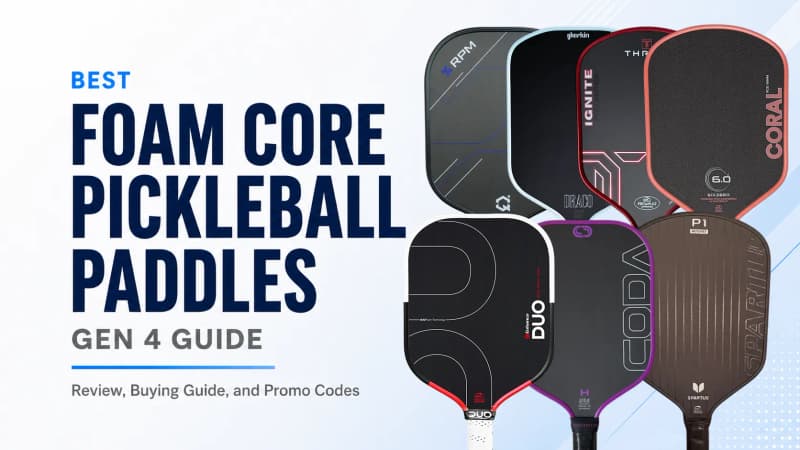
My picks
- 1.11SIX24 Vapor Power 2$99Black FridayBlack Friday price, list $209.99
- 2.Honolulu J2CR Crystal Blue Long Handle$175.50Black FridayBlack Friday price, list $195
- 3.Friday Aura Pro Widebody$118.30Black FridayBlack Friday price, list $169
- 4.Gherkin Draco$161.99code MPBwith code MPB, list $179.99
- 5.Selkirk Boomstik Widebody$249.99Black FridayBlack Friday price, list $333
- 6.Bread & Butter Loco Standard$179.10code MPBwith code MPB, list $199
- 7.Enhance DUO Widebody$174.99Black FridayBlack Friday price, list $199.99
- 8.Engage X2 Widebody$207.99code MPBwith code MPB, list $259.99
- 9.Six Zero Coral Hybrid$150Black FridayBlack Friday price, list $200
This is the foam-core guide. For the overall ranking, foam and honeycomb together, start with the best pickleball paddles page.
Introduction
Foam core pickleball paddles are one of the biggest equipment shifts in the modern paddle market.
Most players call them "Gen 4" paddles, meaning the traditional polypropylene honeycomb core is replaced with solid foam or dual-density foam. That change affects feel, power delivery, durability, sound, and how the paddle responds over time.
Foam core paddles tend to hold their playing characteristics longer than honeycomb builds, and foam gives brands more room to tune feel.
How to pick from this list
Buy the Vapor Power 2 if you want to hit hard and you don't mind adding a little weight.
Buy the J2CR Crystal Blue if spin is the priority. Nothing on this list bites the ball harder.
Buy the Boomstik Widebody if you want power in a paddle that stays stable when you miss the middle.
Buy the Loco Standard if you want most of the Boomstik's power and stability for a lot less money.
Buy the Coral Hybrid if you'd rather soak up pace and place the ball than out-hit people.
Best Foam Core Pickleball Paddles
- 1. 11SIX24 Pickleball Vapor Power 2 16mm — Serve speed 61.1 mph (radar-gun tested, 95th percentile) · Spin 2335 rpm (camera-measured, 90th percentile) · Twist weight 6.6 (64th percentile) · Static weight 7.9 oz (22nd percentile) · Swing weight 108 (10th percentile) · Core 16 mm · Price $210
- 2. Honolulu Pickleball Co. J2CR Crystal Blue Long Handle 16mm — Serve speed 60.4 mph (radar-gun tested, 54th percentile) · Spin 2471 rpm (camera-measured, 98th percentile) · Twist weight 6.4 (48th percentile) · Static weight 8 oz (41st percentile) · Swing weight 108 (13th percentile) · Core 16 mm · Price $195
- 3. Friday Pickleball Aura Pro Widebody 16mm — Serve speed 60.6 mph (radar-gun tested, 69th percentile) · Spin 2289 rpm (camera-measured, 74th percentile) · Twist weight 6.8 (76th percentile) · Static weight 7.9 oz (22nd percentile) · Swing weight 107 (7th percentile) · Core 16 mm · Price $169
- 4. Gherkin Pickleball Draco 16mm — Serve speed 60.9 mph (radar-gun tested, 88th percentile) · Spin 2270 rpm (camera-measured, 55th percentile) · Twist weight 6.8 (73rd percentile) · Static weight 8 oz (46th percentile) · Swing weight 113 (42nd percentile) · Core 16 mm · Price $180
- 5. Selkirk Boomstik Widebody 16mm — Serve speed 60.7 mph (radar-gun tested, 78th percentile) · Spin 2188 rpm (camera-measured, 21st percentile) · Twist weight 7.8 (99th percentile) · Static weight 8.7 oz (99th percentile) · Swing weight 113 (43rd percentile) · Core 16 mm · Price $333
- 6. Bread & Butter Loco Standard 16mm — Serve speed 60.6 mph (radar-gun tested, 69th percentile) · Spin 2285 rpm (camera-measured, 69th percentile) · Twist weight 7.3 (94th percentile) · Static weight 8.1 oz (74th percentile) · Swing weight 110 (19th percentile) · Core 16 mm · Price $199
- 7. Enhance Pickleball DUO Widebody 16mm — Serve speed 60.1 mph (radar-gun tested, 42nd percentile) · Spin 2285 rpm (camera-measured, 69th percentile) · Twist weight 7.3 (93rd percentile) · Static weight 8 oz (52nd percentile) · Swing weight 112 (30th percentile) · Core 16 mm · Price $200
- 8. Engage X2 Widebody 16mm — Serve speed 60.3 mph (radar-gun tested, 50th percentile) · Spin 2289 rpm (camera-measured, 74th percentile) · Twist weight 7.1 (87th percentile) · Static weight 8.2 oz (88th percentile) · Swing weight 111 (27th percentile) · Core 16 mm · Price $260
- 9. Six Zero Pickleball Coral Hybrid 16mm — Serve speed 60.4 mph (radar-gun tested, 54th percentile) · Spin 2259 rpm (camera-measured, 48th percentile) · Twist weight 6.6 (61st percentile) · Static weight 8.1 oz (63rd percentile) · Swing weight 110 (22nd percentile) · Core 16 mm · Price $200
Frequently asked questions
- What is a foam core pickleball paddle?
- A foam core pickleball paddle uses a foam-based interior instead of a traditional polypropylene honeycomb core. That change can affect feel, power delivery, durability, and how the paddle responds across different shots.
- Are foam core paddles better than regular paddles?
- Not automatically. Some are excellent, but foam core isn't a shortcut to better performance. The best choice still depends on your style, preferences, and whether the paddle's tuning fits your game.
- Do foam core paddles last longer?
- They can hold their playing characteristics more consistently over time than some honeycomb-core paddles. That's one of the biggest reasons players are interested in them.
- Are foam core paddles more powerful?
- Some are, but not all. Foam core paddles range from soft, placement-oriented builds to very aggressive power paddles.
- Who should buy a foam core paddle?
- Players who want the newer construction, care about feel and durability, and already have a decent sense of what they like in a paddle are usually the best fit.
- Which paddle on this list has the highest measured spin RPM?
- Honolulu Pickleball Co. J2CR Crystal Blue Long Handle 16mm — 2471 rpm, camera-measured on the same protocol as every other paddle I test.
- Which paddle on this list has the fastest measured serve speed?
- 11SIX24 Pickleball Vapor Power 2 16mm — 61.1 mph, radar-gun tested.
- What is the cheapest paddle on this list?
- Friday Pickleball Aura Pro Widebody 16mm at $169.
Best Foam Core Pickleball Paddles
The Gen 4 foam core paddles I'd shortlist.- 11SIX24 Pickleball Vapor Power 2 16mm
Spin 2,335 RPM · Serve speed 61.1 mph · Weight 7.85 oz · Swing weight 107.55
I don't get excited about many paddles. This one got me. Contact is crisp and you always know where you hit it, and on drives you can feel the ball sit in the face for a split second before it leaves. Swing hard and it hits hard. On soft hands it stays calm, but get pokey on a dink and you'll know it right away. Mine came in on the light side, and 9 grams of weighted tape made my resets a lot better. It's UPA-A only, so check your events before you buy. Use code MPB for a discount.
- Honolulu Pickleball Co. J2CR Crystal Blue Long Handle 16mm
Spin 2,471 RPM · Serve speed 60.4 mph · Weight 7.96 oz · Swing weight 108.4
It's quick, and it doesn't feel like a foam paddle in your hand. At the kitchen the surface grabs, and even soft dinks dip. Hit the middle and it's money, but miss it and you'll feel it, so a little weighted tape helps. It's UPA-A only, and the extra bite fades. By about 50 hours, mine had lost the head start it had when new. Use code MPB for a discount.
- Friday Pickleball Aura Pro Widebody 16mm
Spin 2,289 RPM · Serve speed 60.6 mph · Weight 7.86 oz · Swing weight 106.6
This was the surprise of the Aura Pro line for me. The widebody has a softer, slightly hollow feel that not many paddles have right now, cushioned at contact, but it still hits hard. I think it'll split people. I liked it a lot, because you get more pocketing without giving up offense. It played well stock, and I didn't need to add weight. The handle feels blocky and a little big, and a couple of review samples came apart near the throat, which looked like an early-run problem. Use code MPB for a discount.
- Gherkin Pickleball Draco 16mm
Spin 2,270 RPM · Serve speed 60.9 mph · Weight 7.99 oz · Swing weight 113.05
The Draco has a springy face, and the first few sessions the pop was almost startling. Blocks and counters came back deep with barely any swing. Passive blocks and lazy returns fly long if you're not paying attention, and if you play tight-handed you'll probably fight it. Off-center hits still hold up. I'd hand it to someone with loose hands who swings through the ball. Use code MPB for a discount.
- Selkirk Boomstik Widebody 16mm
Spin 2,188 RPM · Serve speed 60.7 mph · Weight 8.65 oz · Swing weight 113.2
I rolled my eyes at this one at first. Then I watched 3.0 players use it, including my wife, who started finishing points she wasn't finishing before. The power comes off in a straight line. Swing harder and you get more, with no weird jump at half speed, and the ball carries deep. The trade is spin, and $333 is a lot of money. If most of your game is drive and crash, it's your paddle. If not, I'd look at the Omni Widebody first. Use code INF-MPB for a discount.
- Bread & Butter Loco Standard 16mm
Spin 2,285 RPM · Serve speed 60.6 mph · Weight 8.11 oz · Swing weight 109.9
The Loco line hits with real substance. Contact is dense and plush, and you get a beat to shape the shot before it leaves. The power is earned, so you have to swing for it. The Standard is B&B's wide shape, the quickest of the three in hand and the steadiest when you're stretched or catch one off-center. It ships stiff and softens over the first few weeks. I've played the Standard less than the other two shapes, and mine is still the stiffest. Use code MPB for a discount.
- Enhance Pickleball DUO Widebody 16mm
Spin 2,285 RPM · Serve speed 60.1 mph · Weight 8.01 oz · Swing weight 111.65
The DUO Widebody gives you dense, connected feedback without the hollow echo a lot of foam paddles have. It's on the soft side, yoga-mat soft, and I don't mean underpowered. At the net the pop is controlled, enough to be aggressive without sailing balls long. Resets and drops were excellent, and I could get sloppy with my contact and still get away with it. As a complete widebody foam paddle, it's one of the best I've played. Use code MPB for a discount.
- Engage X2 Widebody 16mm
Spin 2,289 RPM · Serve speed 60.3 mph · Weight 8.21 oz · Swing weight 111.15
The X2 Widebody and Elongated are my two favorite Engage paddles, and the elongated is my pick of the pair. The X2 is a quiet paddle. It doesn't announce itself on the first pickup, and then you notice how much control you have. Drops settle and resets come through. The hard part is the price. At $259.99 it's about $90 more than the Aura Pro Widebody, and the face is a plain one with no durable grit. Use code MPB for a discount.
- Six Zero Pickleball Coral Hybrid 16mm
Spin 2,259 RPM · Serve speed 60.4 mph · Weight 8.06 oz · Swing weight 110.4
The first thing I noticed was how fast I could get the Coral moving. It's dense and muted at contact, which buys you time to soak up pace and redirect it, and I kept getting balls back I had no business getting. Mishits stayed in play more than I expected. Drives are fine, but they won't scare anyone. If you'd rather absorb pace and place the ball, it's very, very good. Use code MPB for a discount.
What is a foam core pickleball paddle?
A foam core paddle replaces the traditional polypropylene honeycomb interior with some form of foam-based construction. Examples include the BoomCore system in the Selkirk Boomstik, the dual-density EPP and EVA foam in the Enhance DUO and B&B Loco, and the three-layer ReactCore in the Selkirk Omni (see our Selkirk Omni review).
Foam core paddles differ from traditional honeycomb paddles in how they absorb, store, and return energy. That changes how the ball feels on contact and how the paddle holds up over time.
What "Gen 4" really means
"Gen 4" is what most players call the wave of foam-core paddles that came after Gen 1 cold-pressed paddles, Gen 2 thermoformed paddles, and Gen 3 widened-foam-edge builds, often called "floating core."
What foam core paddles usually do better
Consistency over time is the strongest argument for foam core. Traditional honeycomb paddles lose performance as the core breaks down from repeated impact. Foam core paddles tend to maintain their playing characteristics more reliably. That's the main reason I'd recommend a foam core build over a comparable honeycomb one for players who use their paddle heavily and want the specs they paid for to last.
The design range is also wider. Foam gives brands more flexibility to tune feel, which is why this category includes both soft, muted paddles and some of the most aggressive power paddles available. A good honeycomb build is relatively predictable in what it can do.
Many foam core paddles also feel denser and more connected at contact than honeycomb.
What foam core paddles can make worse
Touch can still be tricky. Some foam core paddles are easier to reset with than Gen 3 builds, but softer doesn't automatically mean easier. Some foam builds are tuned for attack, and soft shots pay for it. On the Draco, a lazy block can sail.
Not all foam paddles are forgiving. Shape, swing weight, twist weight, and mass distribution all still matter.
Foam core paddles usually cost more. The Boomstik at $333 is the high end. Whether the construction is worth the premium depends on how much you play and whether you've felt the performance drop-off on a worn honeycomb build.
Foam core does not mean one play style
The Coral Hybrid is soft and muted, a paddle for placing the ball. Swing fast with the Vapor Power 2 and it hits hard. The Draco is springy enough to startle you for the first few sessions, while the DUO Widebody is dense, steady and forgiving.
Shape still matters with foam core paddles
Widebody and standard shapes give you more forgiveness and a more predictable contact zone. Hybrid shapes split the difference on reach and stability. Elongated shapes add reach and power but become less forgiving if not tuned carefully.
The Boomstik Widebody and Loco Standard are wide shapes, and they're more stable on off-center hits than most elongated foam paddles. The Draco and J2CR Crystal Blue are hybrid shapes, with a bit more reach and a bit less width. The Coral is a hybrid and the DUO is a widebody.
Who should use a foam core paddle?
Foam core paddles make the most sense for players who play a lot and don't mind paying more for a paddle that feels the same months later. Several on this list work well for improving intermediates, but the variety within foam core is wide enough that the wrong one can be a costly mismatch. Match the specs to your game, and if you can demo before buying, do it.
Once the paddle's sorted, see my picks for the best pickleball shoes.