

Bread & Butter Pickleball Paddles (2026): Loco Reviewed
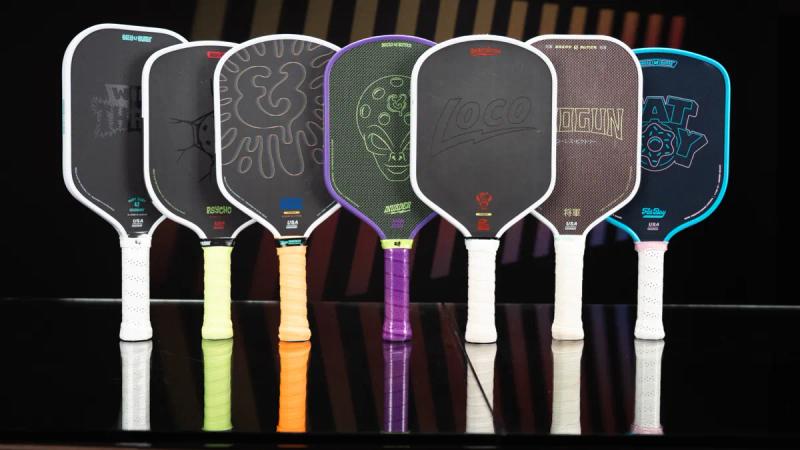
Bread & Butter built its name on bold design and some of the best marketing in pickleball, hot sauce in the box and all. The Loco is the paddle that finally backs the hype with real Gen 4 power. Here's the full lineup with measured numbers and where the money actually goes.

No brand pays to be here or sees the page first.
I play every paddle at least 24 games before I rate it.
Same instruments, same ball, twelve swings per measurement.
Introduction
Bread & Butter is the unconventional, fun-first brand of pickleball, irreverent names and bold graphics over paddles that are well-built and fairly priced. On court its strengths are power and forgiveness, not spin. Then the Loco showed up and gave the brand a real power story. The Loco is a dual-density foam core that comes in three shapes at $199, and it’s the reason most people are searching this brand right now. Pick the shape first, because that decision matters more than anything else here. Not sure which one fits your game? Run it through the Paddle Finder.
Why Bread & Butter Is Actually Worth Paying Attention To
Start with the founder, because it explains the brand. Doug Sapusek is a former Marine who came to pickleball recovering from a Vespa accident, and he’d already built and sold a bandana company before this one. He runs Bread & Butter with his two adult kids. That’s where the irreverent names and the hot sauce in the box come from. This is a family brand that leads with personality.
For most of this brand’s life, the story was the personality. Bold themes, playful color schemes, a koozie and hot sauce in the box, names like Filth and Psycho and FatBoy. None of it takes itself too seriously. But the paddles underneath are well-built and fairly priced, they just weren’t chasing the top of the spec charts. The Filth and the FatBoy measure a 21 and a 12 on our Firepower scale, some of the lowest power numbers in the entire lineup of paddles I’ve tested, because they’re built for touch and control, not for drives. That was the brand: serious paddles, unserious packaging.
One thing the numbers are clear on: spin is not why you buy this brand. Nearly every Bread & Butter paddle I’ve measured runs below average on spin, and the Filth line sits near the bottom of my entire testing pool. The foam Loco is the only line above average, and only by a little. What this brand does well is power and forgiveness. The Loco brings the power, the Filth and FatBoy bring sweet spots big enough to handle sloppy contact. If grip on the ball is your priority, look at a different brand.
Then the Loco landed. The Standard shape posts an 85 Firepower, the Hybrid an 86, the Elongated an 81. That is not a small step up from a 21. That is a different company. The Loco Standard took my Best Widebody award for 2025, and in May 2026 Selkirk acquired Bread & Butter outright, with the founding Sapusek family staying on to run product and marketing. A brand better known for color schemes and packaging than for power is now the paddle everyone argues about on Reddit.
So this page is really two stories. There’s the Loco, which is where the search traffic and the buying intent live, and there’s the rest of the lineup, the honeycomb paddles that run from pure touch to a Gen 2 driver, still on sale and still right for specific players. I’ll cover both, but the Loco is the headline.
The Bread & Butter Lineup at a Glance
Paddle | Shape | Spin | Swing | Price | Best For |
|---|---|---|---|---|---|
Widebody | Above average | Light in hand | $199 | Fast hands, forgiving power | |
Hybrid | Above average | Near average | $199 | Power with control balance | |
Elongated | Near average | Heavy in hand | $199 | Reach, leverage, max drive | |
The rest of the lineup (Gen 2 honeycomb) | |||||
Standard | Below average | Near average | $165 | Pure touch, resets | |
Standard | Below average | Near average | $190 | Softest, most forgiving | |
Elongated | Below average | Heavy in hand | $190 | Reach, composed feel | |
Hybrid | Below average | Near average | $190 | All-court, leans power | |
Elongated | Below average | Near average | $190 | Firmer, offense, tunable | |
Standard | Below average | Light in hand | $120 | Budget pop, quick hands |
Use code MPB for 10% off across the lineup. One naming note: I label the wide shape “Standard,” while Bread & Butter and some reviewers call it the “Widebody.” Same paddle, so don’t let the cross-shopping confuse you.
The Loco ($199)
- 1. Bread & Butter Loco Elongated 16mm — Serve speed 60.9 mph (radar-gun tested, 88th percentile) · Spin 2270 rpm (camera-measured, 55th percentile) · Twist weight 6.1 (21st percentile) · Static weight 7.9 oz (32nd percentile) · Swing weight 119 (81st percentile) · Core 16 mm · Price $199
- 2. Bread & Butter Loco Standard 16mm — Serve speed 60.6 mph (radar-gun tested, 69th percentile) · Spin 2285 rpm (camera-measured, 69th percentile) · Twist weight 7.3 (94th percentile) · Static weight 8.1 oz (74th percentile) · Swing weight 110 (19th percentile) · Core 16 mm · Price $199
- 3. Bread & Butter Loco Hybrid 16mm — Serve speed 60.9 mph (radar-gun tested, 88th percentile) · Spin 2273 rpm (camera-measured, 57th percentile) · Twist weight 6.8 (73rd percentile) · Static weight 8 oz (56th percentile) · Swing weight 114 (47th percentile) · Core 16 mm · Price $199
The Rest of the Lineup
- 1. Bread & Butter Wild Thang 16mm — Serve speed 60 mph (radar-gun tested, 39th percentile) · Spin 2170 rpm (camera-measured, 18th percentile) · Twist weight 5.9 (11th percentile) · Static weight 7.9 oz (28th percentile) · Swing weight 113 (44th percentile) · Core 16 mm · Price $190
- 2. Bread & Butter Loco Elongated 16mm — Serve speed 60.9 mph (radar-gun tested, 88th percentile) · Spin 2270 rpm (camera-measured, 55th percentile) · Twist weight 6.1 (21st percentile) · Static weight 7.9 oz (32nd percentile) · Swing weight 119 (81st percentile) · Core 16 mm · Price $199
- 3. Bread & Butter Psycho 14mm — Serve speed 59.6 mph (radar-gun tested, 29th percentile) · Spin 2110 rpm (camera-measured, 9th percentile) · Twist weight 6.9 (80th percentile) · Static weight 7.9 oz (23rd percentile) · Swing weight 103 (2nd percentile) · Core 14 mm · Price $190
- 4. Bread & Butter FatBoy 16mm — Serve speed 57.6 mph (radar-gun tested, 5th percentile) · Spin 2078 rpm (camera-measured, 5th percentile) · Twist weight 7.3 (95th percentile) · Static weight 8.2 oz (84th percentile) · Swing weight 110 (23rd percentile) · Core 16 mm · Price $190
- 5. Bread & Butter Filth Standard 16mm — Serve speed 59.1 mph (radar-gun tested, 20th percentile) · Spin 2110 rpm (camera-measured, 9th percentile) · Twist weight 7.6 (98th percentile) · Static weight 8.2 oz (83rd percentile) · Swing weight 111 (23rd percentile) · Core 16 mm · Price $165
- 6. Bread & Butter Invader 16mm — Serve speed 58.1 mph (radar-gun tested, 9th percentile) · Spin 2109 rpm (camera-measured, 9th percentile) · Twist weight 6.9 (79th percentile) · Static weight 8.1 oz (70th percentile) · Swing weight 114 (47th percentile) · Core 16 mm · Price $190
- 7. Bread & Butter Filth Hybrid 16mm — Serve speed 59.2 mph (radar-gun tested, 22nd percentile) · Spin 2037 rpm (camera-measured, 4th percentile) · Twist weight 6.9 (79th percentile) · Static weight 8.1 oz (63rd percentile) · Swing weight 113 (38th percentile) · Core 16 mm · Price $165
- 8. Bread & Butter Filth 16mm — Serve speed 58.5 mph (radar-gun tested, 14th percentile) · Spin 1936 rpm (camera-measured, 1st percentile) · Twist weight 6.2 (30th percentile) · Static weight 8 oz (58th percentile) · Swing weight 123 (95th percentile) · Core 16 mm · Price $165
- 9. Bread & Butter Filth Elongated 16mm — Serve speed 58.5 mph (radar-gun tested, 14th percentile) · Spin 2043 rpm (camera-measured, 4th percentile) · Twist weight 6.4 (48th percentile) · Static weight 8.2 oz (88th percentile) · Swing weight 123 (96th percentile) · Core 16 mm · Price $165
- 10. Bread & Butter Shogun 16mm — Serve speed 55.8 mph (radar-gun tested, 1st percentile) · Spin 2168 rpm (camera-measured, 17th percentile) · Twist weight 6.1 (27th percentile) · Static weight 8.2 oz (91st percentile) · Swing weight 123 (95th percentile) · Core 16 mm · Price $190
Frequently asked questions
- Are Bread & Butter paddles good?
- The Loco is one of the better power values on the market right now, full stop. An 85-to-86 Firepower foam core at $199 competes with paddles that cost $250. The older control line is more niche, good if you specifically want soft hands and low power, less interesting if you want an all-around paddle.
- What's the difference between the three Loco shapes?
- Same core, same $199 price, different geometry. The Standard (widebody) is the most forgiving and quickest in hand. The Elongated has the most reach and the highest power but the smallest margin for error on off-center hits. The Hybrid splits the difference and is the one I'd pick if I could only own one.
- Did Selkirk really buy Bread & Butter?
- Yes. Selkirk acquired the company in May 2026. Bread & Butter keeps its own brand, website, and product team under the Sapusek family, with Selkirk handling distribution and scale. The Loco is still the Loco.
- Loco or Filth?
- If you drive the ball well or want any power at all, the Loco . The Filth is a dedicated touch paddle and plays well below the Loco on every power and drive number. They're built for opposite players.
- Is the Loco legal for tournaments?
- The Loco carries USA Pickleball approval, so it's good for USAP-sanctioned events. If you play under a different sanctioning body, verify before you buy.
- Which Loco has the most spin?
- They're close. The Standard edges it at 2285 RPM, with the Hybrid at 2273 and the Elongated at 2270. All three land above average for spin, so shape and feel should drive your pick more than the RPM gap.
- Which paddle on this list has the highest measured spin RPM?
- Bread & Butter Loco Standard 16mm — 2285 rpm, camera-measured on the same protocol as every other paddle I test.
- Which paddle on this list has the fastest measured serve speed?
- Bread & Butter Loco Elongated 16mm — 60.9 mph, radar-gun tested.
- What is the cheapest paddle on this list?
- Bread & Butter Filth Standard 16mm at $165.
The Loco ($199)
Gen 4 | 16mm | USA Pickleball | $199
The Loco name isn't new. The original got discontinued over an IP issue, and this is the rebuilt version, the brand's first true Gen 4 dual-foam paddle. It's a floating-core build, a dense EPP interior with an EVA foam perimeter for stability and dwell, and it plays nothing like the springy Gen 4 paddles that send resets sailing long. If you've hit the Honolulu J2NF or J2FC+, you already know the feel; the Loco plays like a close cousin. It plays dense. There's a solid, plush compression at contact that holds the ball a beat before it leaves, which is unusual for something putting up these power numbers. You get 90th-percentile drive output without the runaway trampoline feel. Next to Selkirk's Boomstik, the Loco is the easier paddle to control, far less of that runaway pop that sends resets sailing long, which is why it lands near the top of our best power paddles list. Foam cores like it have taken over the category, our most-popular paddles are now all foam, not one honeycomb. That combination is the whole pitch, and the three shapes split it up differently.
One note worth knowing before you buy: all three Locos break in. They ship stiff and soften slightly over the first several weeks of play, picking up more dwell as they go. The Hybrid I've had longest plays noticeably more connected now than it did new. If you read an early first-impression that called it too firm, that's part of the reason. Two things that lower the risk: there's a 30-day trial, so you can play it through the break-in before you commit, and a six-month workmanship warranty. That's shorter than Selkirk's lifetime coverage, worth knowing, but the trial window matters more at this price. Code MPB drops the $199 to around $180. One honest watch-out: the surface grit isn't the most durable in my testing, so the spin you do get can fade with heavy use. For the full breakdown, here's the written Loco review and the video walkthrough, and if you're still wrapping your head around what foam core actually changes, the Gen 4 foam core guide walks through it.
- Bread & Butter Loco Elongated 16mm
Spin 2,270 RPM · Serve speed 60.9 mph · Weight 7.91 oz · Swing weight 118.6
Loco Elongated. Maximum reach, maximum leverage, serve speed in the 95th percentile. The dense foam keeps the power controlled, and the coarse peel-ply surface grabs the ball well on rolls and serves. The catch is the twist weight, 6.05, the lowest of the three. That means stability on off-center contact is a bit more prone to twisting in your hand. Catch one off-center and you feel it, more than you do on the Standard. This is the driver's paddle, and you need cleaner contact to get the most out of it. → Buy the Loco Elongated ($199)
- Bread & Butter Loco Standard 16mm
Spin 2,285 RPM · Serve speed 60.6 mph · Weight 8.11 oz · Swing weight 109.9
Loco Standard. This is the widebody, and it's the one I'd hand most players. Swing weight sits at 109.9, the lightest of the three, so it's quick in hand and easy to reload at the kitchen. Twist weight is the highest in the line, which means off-center contact stays stable and the sweet spot holds. Punch volley pop is elite, top of the chart. You give up some reach versus the elongated, but you gain forgiveness and hand speed, and the spin and drive output barely move. → Buy the Loco Standard ($199)
- Bread & Butter Loco Hybrid 16mm
Spin 2,273 RPM · Serve speed 60.9 mph · Weight 8.03 oz · Swing weight 114
Loco Hybrid. The middle option, and the one that's logged the most play time for me. Swing weight is 114, twist weight 6.75, so it sits between the Standard's quickness and the Elongated's reach. Serve speed is 90th percentile, spin sits just above average, and touch shots play more connected than most power paddles. Drops stay on target, resets don't float. Pop during hand battles sits in the middle range, fast enough to win speedups without getting away from you. If you want one Loco that does a little of everything, it's this. → Buy the Loco Hybrid ($199)
The Rest of the Lineup
These aren't previous-generation Locos. They're a separate Gen 2 honeycomb line that runs wider than people assume, from pure touch to a Gen 2 driver, and several are still the right buy for the right player.
The Filth is the control play, a raw T700 carbon face in Standard, Hybrid, and Elongated at $165, spin around the 22nd percentile and power near the 5th. You don't blast winners with it, you place the ball. The FatBoy at $190 is the softest and most forgiving paddle in the lineup. The Shogun at $190 adds a titanium face and elongated reach with a composed, balanced feel. The Invader at $190 is the all-court hybrid, a fiberglass layer under the carbon for extra pop, and it leans power more than the others, fitting since it's the paddle that replaced the original Loco. The Wild Thang at $190 is the outlier, a firmer, faster Gen 2 driver with 3K carbon over fiberglass and a tight sweet spot. It needs tuning to settle, weighted tape up the neck and a firmer ball, but dialed in it hits clean. Think of it as the Shogun after a few weeks in the weight room. The Psycho is the value pick at $120, a thinner 14mm core with more pop and quicker hands.
Use code MPB for 10% off. If you want touch, start with the Filth or FatBoy. If budget is the constraint, start with the Psycho.
How the Loco Stacks Up Against the Field
The decision most people are actually making: Loco vs Boomstik. Selkirk's Boomstik Widebody is the paddle the Loco gets cross-shopped against most, and the lab data flips the usual story. The assumption is that the $333 Boomstik buys more power and more spin. It doesn't. The Loco Standard and the Boomstik tie at 85 Firepower, and the Loco out-spins it, 2285 RPM to 2188. What the extra money buys on the Boomstik is a bigger sweet spot, a 7.8 twist weight to the Loco's 7.3, and a lot more mass. At 8.65 ounces it's one of the heaviest paddles I've tested, so weight-sensitive arms will feel it. The Loco is lighter, spins more, ties the power, and runs about $180 with code against the Boomstik's $333. For most players that's the smarter buy. The Boomstik earns the gap only if you want the biggest, most stable sweet spot in the category and don't mind the weight. And yes, Selkirk now owns both.
The value-foam benchmark: Honolulu J2NF. At $195 the J2NF is the other foam paddle worth cross-shopping, and it's where the family resemblance shows. Both are floating-core builds, and the Loco plays like a close cousin. The J2NF is the crisper, more control-leaning of the two at 58 Firepower, where the Loco brings real drive. Want foam feel with touch, take the J2NF. Want foam feel with power, take the Loco.
Same build and price, less power: Enhance DUO. The DUO Widebody and DUO Elongated share the Loco's exact dual-density foam at the same $199, but land at 68 and 60 Firepower against the Loco's 85 and 81. Same recipe, less output. It's the closest thing to the Loco's actual feel if you want it a touch softer.
Matches the power number, different feel: Draco and Friction Pro. The Gherkin Draco Widebody hits 81 Firepower for $179.99, close to the Loco Standard on paper, but it's a nanocellulose core, so the number matches and the feel may not. In the elongated, the RPM Friction Pro matches the Loco's 81 exactly but costs $249.99.
Hybrid power and spin: Dark Matter and J2CR. The Vulcan Dark Matter Hybrid is the nearest on power at 78 Firepower, but it's $249.99. The Honolulu J2CR at $195 trades power for spin, a 74 Firepower but 2471 RPM, well above the Loco Hybrid's 2273, the pick if grip matters more than drive.
The throughline: at about $180 with code, the Loco ties or beats paddles that cost $250 to $333 on power, and the same-price foam paddles that share its build give up 15 to 25 Firepower points. That's the value case in one sentence.
Who Each Paddle Is For
Loco Standard: Fast-hands players who want the power without the penalty. It's the most forgiving widebody of the three and the quickest to reload at the net, and it gives up almost nothing on spin or drive to get there. If you're not sure which Loco, start here.
Loco Hybrid: The balance pick, and the best of the brand's hybrid shapes. Enough reach for drives, quick enough for kitchen exchanges, stable enough to stay consistent. If you want one paddle that handles the whole court and you don't have a specific weakness you're solving for, this is it.
Loco Elongated: Drivers with clean contact who want every inch of reach and leverage out of an elongated. The power and serve speed are the highest in the line, but the lower twist weight means you pay for off-center hits. Strong mechanics required.
The Gen 2 line (Filth, FatBoy, Shogun, Invader, Wild Thang, Psycho): Players who want a specific feel more than raw power. The Filth and FatBoy are for soft hands and resets, the Shogun for composed reach, the Invader for all-court players who still want pop, the Wild Thang for drivers willing to tune, the Psycho for a budget. Go in knowing what you're buying, because none of these match the Loco's power.
The Call
For most players, the Loco Standard is the buy. It's the most forgiving shape, it's quick in hand, and it gives up almost nothing on power or spin to the other two. Drivers who want reach should take the Elongated and bring clean contact. Play singles? Go elongated. Everyone in between takes the Hybrid and doesn't think twice. The Gen 2 line is still there if touch or a specific feel is your whole game, but the Loco is why this brand is worth talking about in 2026.
One more thing. Selkirk now sells three power widebodies: the $333 Boomstik, its own $200 ERA Power, and the $199 Loco it just bought. The ERA Power tops out at 52 Firepower. The Loco ties the Boomstik at 85, for $134 less. Of the three on Selkirk's shelf, the one they acquired might be the best value of the lot.
Grab the Loco at Bread & Butter with code MPB for 10% off, or run your game through the Paddle Finder first.
Disclosure
Disclosure: Paddles in this post may have been provided by the brand at no cost. No money changed hands and no content was required in exchange. Affiliate links are used where noted. Purchases made through these links support this site at no additional cost to you.
My overall picks, across every brand and price, are in my best pickleball paddles guide.
Watch on YouTube: Bread & Butter Pickleball Paddles (2026): Loco Reviewed
Watch on YouTube: Bread & Butter Pickleball Paddles (2026): Loco Reviewed
Watch on YouTube: Bread & Butter Pickleball Paddles (2026): Loco Reviewed
Watch on YouTube: Bread & Butter Pickleball Paddles (2026): Loco Reviewed