

Best Budget Pickleball Paddles Under $100 (2026)
Seven paddles that cost $100 or less with code MPB. Every one measured and played.

No brand pays to be here or sees the page first.
I play every paddle at least 24 games before I rate it.
Same instruments, same ball, twelve swings per measurement.
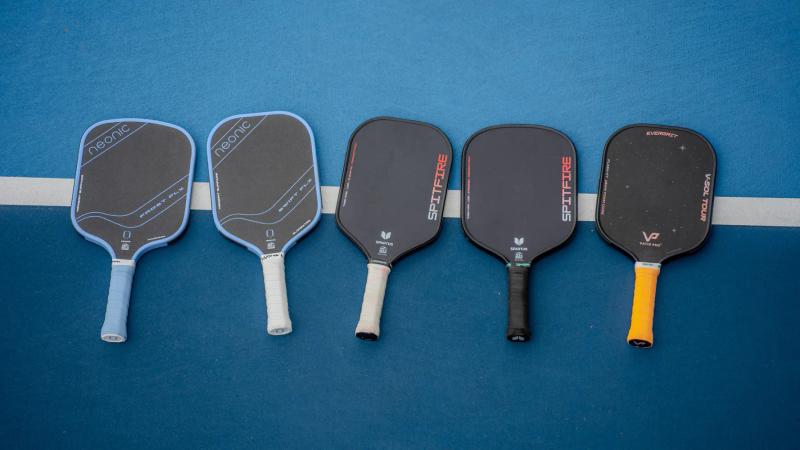
My picks
- 1.Spartus Spitfire ElongatedBest overall$99.99Black FridayBlack Friday price, list $109.99
- 2.Spartus Spitfire WidebodyBest widebody$98.99code MPBwith code MPB, list $109.99
- 3.Neonic Frost FLX NeoGritMost spin in a hybrid$90Black FridayBlack Friday price, list $110
- 4.Neonic Swift FLX NeoGritMost spin$90Black FridayBlack Friday price, list $110
- 5.Vatic Pro V-Sol Tour Flash FTBest V-Sol Tour shape$99.99code MPBwith code MPB, list $109.99
- 6.Pickleball Apes Harmony VMost forgiving$59Black FridayBlack Friday price, list $79.99
- 7.Warping Point NeonBest Gen 3 honeycomb build$79.99Black FridayBlack Friday price, list $99.99
Black Friday prices are lower than the ones written below. The My picks box has today's price for each paddle.
Every paddle on this page costs $100 or less with code MPB. Prices are listed before and after the code.
My pick for most people is the Spartus Spitfire Elongated, $109.99 or $98.99 with code MPB.
Compare the picks
Paddle | Price with code | Spin (RPM) | Serve speed (mph) | Swing weight | Twist weight | Shape | Approval |
|---|---|---|---|---|---|---|---|
Spartus Spitfire Elongated | $98.99 | 2,347 | 60.7 | 114.95 | 6.20 | Elongated | USA Pickleball |
Spartus Spitfire Widebody | $98.99 | 2,441 | 60.4 | 106.65 | 7.15 | Standard | USA Pickleball |
Neonic Frost FLX NeoGrit | $99 | 2,468 | 60.2 | 109.10 | 6.30 | Hybrid | USA Pickleball |
Neonic Swift FLX NeoGrit | $99 | 2,480 | 60.1 | 109.80 | 5.80 | Elongated | USA Pickleball |
Vatic Pro V-Sol Tour Flash FT | $99.99 | 2,395 | 60.5 | 109.85 | 5.95 | Hybrid | USA Pickleball |
Pickleball Apes Harmony V | $71.99 | 2,290 | 59.2 | 107.30 | 7.35 | Standard | USA Pickleball |
Warping Point Neon | about $90 | 2,250 | 60.6 | 112.80 | 6.20 | Elongated | UPA-A |
Higher twist weight means the face twists less on an off-center hit. Lower swing weight means the paddle feels quicker in your hand.
How I chose
I've played every paddle here, the Spitfire Elongated for more than 50 hours.
I don't rate a paddle until I've played it at least 24 games.
Each one is measured on the same instruments, with the same Franklin X-40 ball and twelve swings per measurement, averaged. I've measured 643 paddles this way. See the full paddle data study.
Every pick costs $100 or less with my code, at the brand's own store.
Where I have grit wear data, it's here. Grit that wears off fast costs you spin over a season.
No brand paid to be on this page, and no brand saw it before publishing.
Best Pickleball Paddles Under $100
- 1. Spartus Spitfire Elongated 16mm — Serve speed 60.7 mph (radar-gun tested, 78th percentile) · Spin 2347 rpm (camera-measured, 91st percentile) · Twist weight 6.2 (30th percentile) · Static weight 7.7 oz (7th percentile) · Swing weight 115 (54th percentile) · Core 16 mm · Price $110
- 2. Spartus Spitfire Widebody 16mm — Serve speed 60.4 mph (radar-gun tested, 54th percentile) · Spin 2441 rpm (camera-measured, 97th percentile) · Twist weight 7.2 (89th percentile) · Static weight 7.8 oz (19th percentile) · Swing weight 107 (7th percentile) · Core 16 mm · Price $110
- 3. Neonic Frost FLX NeoGrit 16mm — Serve speed 60.2 mph (radar-gun tested, 45th percentile) · Spin 2468 rpm (camera-measured, 98th percentile) · Twist weight 6.3 (41st percentile) · Static weight 7.6 oz (1st percentile) · Swing weight 109 (16th percentile) · Core 16 mm · Price $110
- 4. Neonic Swift FLX NeoGrit 16mm — Serve speed 60.1 mph (radar-gun tested, 42nd percentile) · Spin 2480 rpm (camera-measured, 99th percentile) · Twist weight 5.8 (6th percentile) · Static weight 7.6 oz (2nd percentile) · Swing weight 110 (19th percentile) · Core 16 mm · Price $110
- 5. Vatic Pro V-Sol Tour Flash FT 16mm — Serve speed 60.5 mph (radar-gun tested, 61st percentile) · Spin 2395 rpm (camera-measured, 95th percentile) · Twist weight 6 (13th percentile) · Static weight 7.9 oz (22nd percentile) · Swing weight 110 (19th percentile) · Core 16 mm · Price $110
- 6. Pickleball Apes Harmony V 16mm — Serve speed 59.2 mph (radar-gun tested, 22nd percentile) · Spin 2290 rpm (camera-measured, 76th percentile) · Twist weight 7.4 (95th percentile) · Static weight 8 oz (39th percentile) · Swing weight 107 (8th percentile) · Core 16 mm · Price $80
- 7. Warping Point Neon 16mm — Serve speed 60.6 mph (radar-gun tested, 69th percentile) · Spin 2250 rpm (camera-measured, 44th percentile) · Twist weight 6.2 (30th percentile) · Static weight 7.9 oz (36th percentile) · Swing weight 113 (39th percentile) · Core 16 mm · Price $100
Frequently asked questions
- What is the best pickleball paddle under $100?
- The Spartus Spitfire Elongated. It's $109.99, $98.99 with code MPB, and it measures 2,347 RPM of spin, higher than 91% of the paddles I've measured.
- Which paddle under $100 has the most spin?
- The Neonic Swift FLX NeoGrit, at 2,480 RPM, higher than 99% of the paddles I've measured. It's $110, $99 with code MPB.
- Which paddle under $100 is best for beginners?
- The Pickleball Apes Harmony V. It has the highest twist weight on this page, 7.35, and a light 107.3 swing weight, and it's $71.99 with code MPB.
- Are $100 paddles worth it?
- Yes. Five of the seven paddles on this page measure higher on spin than at least 91% of the paddles I've measured.
- Which paddle on this list has the highest measured spin RPM?
- Neonic Swift FLX NeoGrit 16mm — 2480 rpm, camera-measured on the same protocol as every other paddle I test.
- Which paddle on this list has the fastest measured serve speed?
- Spartus Spitfire Elongated 16mm — 60.7 mph, radar-gun tested.
- What is the cheapest paddle on this list?
- Pickleball Apes Harmony V 16mm at $80.
Best Pickleball Paddles Under $100
Seven picks, each $100 or less with code MPB. My pick for most people is first.
- Spartus Spitfire Elongated 16mm
Spin 2,347 RPM · Serve speed 60.7 mph · Weight 7.72 oz · Swing weight 114.95
Best overall.
$109.99, or $98.99 with code MPB at gospartus.com
The Spartus Spitfire Elongated is the best paddle under $100 with a code, and it's the one I'd hand a friend.
Best for: players who want spin first and a light, easy swing.
Pros
2,347 RPM of spin, higher than 91% of the paddles I've measured
Grabs the ball from the first hit, with no break-in
Light in hand for an elongated
Cons
Grit wears: 14% lower after 30 hours, about 19% lower after 50
Not built for explosive hand speed on quick punches
Why I picked it. Spin is the story. I feel the bite on serves, rolls and dinks. Power is real but it carries through the ball more than it springs off the face. More plow than pop, and I like that. It doesn't feel, play or perform cheap.
Specs: 7.72 oz | 114.95 swing weight | 6.2 twist weight | 60.7 mph serve speed (faster than 78%) | 39.0 mph punch volley | 5.5 in handle | power: medium. Full Spitfire review | Measured data
- Spartus Spitfire Widebody 16mm
Spin 2,441 RPM · Serve speed 60.4 mph · Weight 7.83 oz · Swing weight 106.65
Best widebody.
$109.99, or $98.99 with code MPB at gospartus.com
The Spartus Spitfire Widebody spins more than the Elongated, 2,441 RPM to 2,347, with a bigger sweet spot and a lighter swing.
Best for: doubles players who want forgiveness and spin in a light paddle.
Pros
2,441 RPM of spin, higher than 97% of the paddles I've measured
7.15 twist weight and a big sweet spot
39.4 mph punch volley, faster than 94%
Cons
Outdoors, finishing a point sometimes takes a little more effort.
Shorter 5.3 in handle
Why I picked it. It's way more poppy than the Elongated, and I don't consider poppy a bad thing. The sweet spot is big, with none of the instability or drop-off that sometimes comes with paddles in this weight range. I added weight, half a gram per inch up both sides, which toned the pop down a little and added stability and power.
Specs: 7.83 oz | 106.65 swing weight | 7.15 twist weight | 60.4 mph serve speed | 39.4 mph punch volley | 5.3 in handle | power: high. Measured data
- Neonic Frost FLX NeoGrit 16mm
Spin 2,468 RPM · Serve speed 60.2 mph · Weight 7.57 oz · Swing weight 109.1
Most spin in a hybrid.
$110, or $99 with code MPB at neonicpickleball.com
The Neonic Frost FLX NeoGrit spins faster than 98% of the paddles I've measured, and I have 40 hours of play on its face.
Best for: players who want spin and durable grit in a very light hybrid.
Pros
2,468 RPM of spin
NeoGrit face at 11.02 Ra, rougher than 99% of the faces I've measured
40 hours of game play on mine, and the surface hardly looks used
6.3 twist weight, the more forgiving of the two FLX shapes
Cons
Really light at 7.57 oz. Expect to tune it with some weight.
Serve speed is average, 60.2 mph
Why I picked it. The grit is the story. The original FLX had a raw carbon fiber face, and my biggest knock was that it didn't have durable grit. I've got 40 hours of game play on this one. 16 of those hours are mine, and the rest came from friends I loaned it to. Nothing I've seen in how it plays suggests the spin has dropped, and the surface hardly looks used. Just go into the FLX series expecting to tune it with some weight.
Specs: 7.57 oz | 109.1 swing weight | 6.3 twist weight | 60.2 mph serve speed | 39.1 mph punch volley | 5.6 in handle | power: medium. Measured data
- Neonic Swift FLX NeoGrit 16mm
Spin 2,480 RPM · Serve speed 60.1 mph · Weight 7.58 oz · Swing weight 109.8
Most spin.
$110, or $99 with code MPB at neonicpickleball.com
The Neonic Swift FLX NeoGrit has the most spin on this page, 2,480 RPM, in the elongated FLX shape.
Best for: players who want an elongated with maximum spin and a light swing.
Pros
2,480 RPM of spin, higher than 99% of the paddles I've measured
NeoGrit face at 11.16 Ra, rougher than 99% of the faces I've measured
39.3 mph punch volley, faster than 90%
Cons
5.8 twist weight, the lowest on this page, so off-center hits twist more
Really light at 7.58 oz. Expect to add weight.
Why I picked it. It's the same super light build and the same NeoGrit face as the Frost, in the elongated shape. Both are $55 less than the original FLX was in July, and at $110 before code they have the Spitfire right in their crosshairs.
Specs: 7.58 oz | 109.8 swing weight | 5.8 twist weight | 60.1 mph serve speed | 39.3 mph punch volley | 5.6 in handle | power: medium. Measured data
- Vatic Pro V-Sol Tour Flash FT 16mm
Spin 2,395 RPM · Serve speed 60.5 mph · Weight 7.86 oz · Swing weight 109.85
Best V-Sol Tour shape.
$109.99, or $99.99 with code MPB ($10 off) at vaticpro.com
The Vatic Pro V-Sol Tour Flash FT is my favorite shape in the Tour line, with 2,395 RPM of spin in a light-swinging hybrid.
Best for: players who want spin and a quick, light hybrid with a longer handle.
Pros
2,395 RPM of spin, higher than 95% of the paddles I've measured
The lightest swing of the Tour shapes, 109.85
Longer 5.75 in handle for two-handed backhands and reach
Cons
Low twist weight, 5.95, so off-center hits twist more
A little stiff fresh. The Tours soften after time on them.
Why I picked it. The flat-top FT is my favorite of the Tour shapes. Next to the regular Flash it spins more, 2,395 RPM to 2,381, and swings lighter, 109.85 to 113.55. The Tour line is the stiffest and most hollow of Vatic's V-Sol paddles, with a grit Vatic calls EverGrit. It reminds me of HexGrit, with smaller particles packed less densely.
Specs: 7.86 oz | 109.85 swing weight | 5.95 twist weight | 60.5 mph serve speed | 39.5 mph punch volley | 8.216 Ra | power: medium. Measured data
- Pickleball Apes Harmony V 16mm
Spin 2,290 RPM · Serve speed 59.2 mph · Weight 7.95 oz · Swing weight 107.3
Most forgiving.
$79.99, or $71.99 with code MPB at pickleballapes.com
The Pickleball Apes Harmony V is the most forgiving and the cheapest paddle on this page.
Best for: newer players, and anyone who wants a stable, quick paddle without paying for power.
Pros
7.35 twist weight, the most stable on this page
107.3 swing weight, quick in hand
Plays the same from the first game, with no break-in
Cons
Low power: 59.2 mph serve speed. You supply the pace.
Gen 3 honeycomb, not foam
Why I picked it. It's a Gen 3 build with a polyurethane foam insert instead of EVA, fiberglass edge walls, and a raw carbon peel-ply face. The V is the standard shape and the most forgiving of the three Harmony shapes.
Specs: 7.95 oz | 107.3 swing weight | 7.35 twist weight | 2,290 RPM spin (higher than 76%) | 37.6 mph punch volley | 5.5 in handle | power: low. Full Harmony review | Measured data
- Warping Point Neon 16mm
Spin 2,250 RPM · Serve speed 60.6 mph · Weight 7.93 oz · Swing weight 112.8
Best Gen 3 honeycomb build.
$99.99, about $90 with code MPB at warpingpoint.com
The Warping Point Neon is the pick if you want a thermoformed honeycomb paddle under $100, but the Spitfire is the better paddle.
Best for: players who prefer a honeycomb core and don't play USA Pickleball sanctioned events.
Pros
Thermoformed, unibody, with three layers of raw T700 carbon, a build usually priced at $150 to $300
60.6 mph serve speed, faster than 69% of the paddles I've measured
Cons
UPA-A approved only
Spin is average, 2,250 RPM
Why I picked it. The face is softer than most raw carbon builds in its class. Next to the Spitfire, though, it loses: the Spitfire plays better, feels better, performs better, and its surface will last longer.
Specs: 7.93 oz | 112.8 swing weight | 6.2 twist weight | 38.9 mph punch volley | 5.5 in handle | power: high. Full Neon review | Measured data
How to choose a paddle under $100
When a friend asks me what paddle to buy, I ask one question first. Do you need more power, more control, or something right in the middle? Every pick on this page says which it is at the end of its specs line.
Start with shape. Most people I know play doubles, so I point them to a widebody or a hybrid for the forgiveness. On this page that's the Spitfire Widebody or the Frost FLX NeoGrit. If you have a tennis background, or you're a more advanced player, then I might recommend an elongated. Check handle length if you hit two-handed backhands.
Then check two numbers. Twist weight is how much the face resists twisting when you miss the center, and I'd look for 6.2 or higher. Two paddles here sit under that, the Swift FLX NeoGrit at 5.8 and the V-Sol Tour Flash FT at 5.95, and I picked them anyway for the spin. Swing weight is how heavy the paddle feels when you swing it. I look for 117 or lower, and every paddle on this page is under that.
Grit. The durable grits are typically better than a raw carbon fiber face, and you can get one for under $100 now. Both Spitfires, both Neonics and the V-Sol Tour Flash FT have it. The Harmony V and the Neon are raw carbon.
Foam or honeycomb. Five of the seven are foam. The Harmony V and the Neon are both honeycomb (Gen 3) builds.
Approval. If you play sanctioned USA Pickleball events, buy a USA Pickleball approved paddle. The Neon is UPA-A only.
The biggest mistake I see at this price is buying off the wall at a big-box sporting goods store. Almost none of what's there is worth buying, and for the same money you can have any paddle on this page. And ignore the back of the package. "Power 10." "Spin 9.5." Look the paddle up on this site first, and if you still have questions, send me a message. I'm always happy to help.
What I'd skip under $100
Two-packs under $50. You'll replace them within a few months, and a $40 paddle now plus a $100 paddle later costs more than the $100 paddle today.
About the tester
Matt Khoury runs Matt's Pickleball. He has measured 643 pickleball paddles on the same instruments and plays every paddle at least 24 games before he rates it. Brands send paddles at no cost. No brand pays for placement or sees a page before it's published. Matt earns a commission when you buy through his links, the same whether he recommends a paddle or tells you to skip it. How I test paddles and disclosure
My overall picks, across every brand and price, are in my best pickleball paddles guide.