

Best Pickleball Paddles for Advanced Players (2026)
The best pickleball paddles for advanced players offer high-end performance without hiding the tradeoffs. This guide breaks down what advanced players should actually look for and which paddles stand out when control, pace, hand speed, and precision all matter.

No brand pays to be here or sees the page first.
I play every paddle at least 24 games before I rate it.
Same instruments, same ball, twelve swings per measurement.
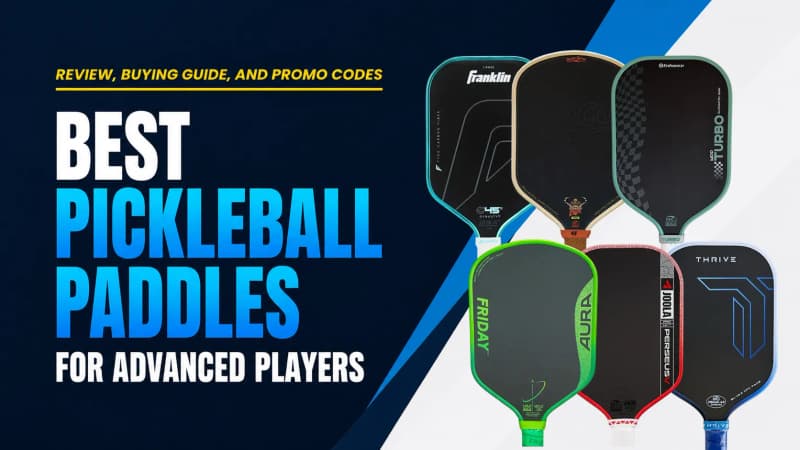
My picks
- 1.JOOLA Perseus Pro V$299.95
- 2.JOOLA Perseus Pro IV$249.95
- 3.JOOLA Scorpeus Pro IV 14mm$229.95
- 4.JOOLA Scorpeus Pro IV 16mm$229.95
- 5.Thrive Fury Elongated$134.99Black FridayBlack Friday price, list $179.99
- 6.Thrive Fury Hybrid$149.99Black FridayBlack Friday price, list $199.99
- 7.Friday Aura Hybrid$152.10code MPBwith code MPB, list $169
- 8.Friday Aura Widebody$116.10code MPBwith code MPB, list $129
- 9.Friday Aura Elongated$116.10code MPBwith code MPB, list $129
- 10.Friday Aura Pro Elongated$118.30Black FridayBlack Friday price, list $169
Introduction
Advanced players usually know when a paddle fits and when it doesn't.
At this level, the goal is no longer just to find something forgiving or easy to use. The goal is to find a paddle that matches how you actually play. Some advanced players want maximum pace and pressure. Others want fast hands, stability, and easier countering. And plenty just want a balanced paddle that can handle every part of the game without giving up too much in any one area.
That's what makes this category different.
The best paddles for advanced players aren't automatically the most powerful or the most expensive. They're the paddles that deliver high-level performance with enough clarity, predictability, and specialization to match more developed mechanics and shot selection.
At Matt’s Pickleball, I test paddles using both on-court play and performance data. That includes serve speed, punch volley speed, spin RPM, swing weight, twist weight, and real-world playability. For advanced players, I care a lot about whether a paddle performs at a high level without masking its tradeoffs.
This guide focuses on paddles that make sense for experienced players who know what they want, or at least know what they don't want.
Not sure where to start? See our full best pickleball paddles ranking for the top picks across every category.
Best Pickleball Paddles for Advanced Players
- 1. JOOLA Perseus Pro V 16mm — Serve speed 60.5 mph (radar-gun tested, 61st percentile) · Spin 2288 rpm (camera-measured, 73rd percentile) · Twist weight 6.4 (45th percentile) · Static weight 8.2 oz (80th percentile) · Swing weight 121 (90th percentile) · Core 16 mm · Price $300
- 2. JOOLA Perseus Pro IV 16mm — Serve speed 60.8 mph (radar-gun tested, 83rd percentile) · Spin 2236 rpm (camera-measured, 39th percentile) · Twist weight 6.4 (48th percentile) · Static weight 8.1 oz (70th percentile) · Swing weight 117 (68th percentile) · Core 16 mm · Price $250
- 3. JOOLA Scorpeus Pro IV 14mm — Serve speed 60.2 mph (radar-gun tested, 45th percentile) · Spin 2187 rpm (camera-measured, 21st percentile) · Twist weight 7.4 (95th percentile) · Static weight 8.3 oz (92nd percentile) · Swing weight 114 (49th percentile) · Core 14 mm · Price $230
- 4. JOOLA Scorpeus Pro IV 16mm — Serve speed 60.6 mph (radar-gun tested, 69th percentile) · Spin 2221 rpm (camera-measured, 35th percentile) · Twist weight 7.4 (96th percentile) · Static weight 8.2 oz (91st percentile) · Swing weight 115 (54th percentile) · Core 16 mm · Price $230
- 5. Thrive Fury Elongated 15.5mm — Serve speed 61 mph (radar-gun tested, 92nd percentile) · Spin 2272 rpm (camera-measured, 56th percentile) · Twist weight 6.1 (27th percentile) · Static weight 7.9 oz (30th percentile) · Swing weight 116 (64th percentile) · Core 16 mm · Price $180
- 6. Thrive Fury Hybrid 15.5mm — Serve speed 60.7 mph (radar-gun tested, 78th percentile) · Spin 2203 rpm (camera-measured, 28th percentile) · Twist weight 6.5 (54th percentile) · Static weight 8.1 oz (63rd percentile) · Swing weight 112 (31st percentile) · Core 16 mm · Price $200
- 7. Friday Pickleball Aura Hybrid 16mm — Serve speed 60.9 mph (radar-gun tested, 88th percentile) · Spin 2293 rpm (camera-measured, 79th percentile) · Twist weight 6 (13th percentile) · Static weight 7.8 oz (17th percentile) · Swing weight 110 (20th percentile) · Core 16 mm · Price $169
- 8. Friday Pickleball Aura Widebody 16mm — Serve speed 60.8 mph (radar-gun tested, 83rd percentile) · Spin 2289 rpm (camera-measured, 74th percentile) · Twist weight 6.6 (64th percentile) · Static weight 7.9 oz (23rd percentile) · Swing weight 107 (6th percentile) · Core 16 mm · Price $129
- 9. Friday Pickleball Aura Elongated 16mm — Serve speed 61.1 mph (radar-gun tested, 95th percentile) · Spin 2299 rpm (camera-measured, 83rd percentile) · Twist weight 5.9 (8th percentile) · Static weight 8.1 oz (74th percentile) · Swing weight 116 (66th percentile) · Core 16 mm · Price $129
- 10. Friday Pickleball Aura Pro Elongated 16mm — Serve speed 61 mph (radar-gun tested, 92nd percentile) · Spin 2295 rpm (camera-measured, 80th percentile) · Twist weight 6 (16th percentile) · Static weight 8.1 oz (74th percentile) · Swing weight 116 (62nd percentile) · Core 16 mm · Price $169
- 11. Bread & Butter Loco Standard 16mm — Serve speed 60.6 mph (radar-gun tested, 69th percentile) · Spin 2285 rpm (camera-measured, 69th percentile) · Twist weight 7.3 (94th percentile) · Static weight 8.1 oz (74th percentile) · Swing weight 110 (19th percentile) · Core 16 mm · Price $199
- 12. Bread & Butter Loco Hybrid 16mm — Serve speed 60.9 mph (radar-gun tested, 88th percentile) · Spin 2273 rpm (camera-measured, 57th percentile) · Twist weight 6.8 (73rd percentile) · Static weight 8 oz (56th percentile) · Swing weight 114 (47th percentile) · Core 16 mm · Price $199
- 13. Bread & Butter Loco Elongated 16mm — Serve speed 60.9 mph (radar-gun tested, 88th percentile) · Spin 2270 rpm (camera-measured, 55th percentile) · Twist weight 6.1 (21st percentile) · Static weight 7.9 oz (32nd percentile) · Swing weight 119 (81st percentile) · Core 16 mm · Price $199
- 14. Selkirk Boomstik Widebody 16mm — Serve speed 60.7 mph (radar-gun tested, 78th percentile) · Spin 2188 rpm (camera-measured, 21st percentile) · Twist weight 7.8 (99th percentile) · Static weight 8.7 oz (99th percentile) · Swing weight 113 (43rd percentile) · Core 16 mm · Price $333
- 15. Selkirk Boomstik Elongated 16mm — Serve speed 60.8 mph (radar-gun tested, 83rd percentile) · Spin 2294 rpm (camera-measured, 80th percentile) · Twist weight 6.7 (67th percentile) · Static weight 8.2 oz (89th percentile) · Swing weight 117 (73rd percentile) · Core 16 mm · Price $333
- 16. Franklin C45 Hayden Patriquin 16mm — Serve speed 60.1 mph (radar-gun tested, 42nd percentile) · Spin 2245 rpm (camera-measured, 43rd percentile) · Twist weight 6 (16th percentile) · Static weight 7.9 oz (28th percentile) · Swing weight 116 (61st percentile) · Core 16 mm · Price $230
- 17. Franklin C45 Parris Todd 13.25mm — Serve speed 59.9 mph (radar-gun tested, 36th percentile) · Spin 2166 rpm (camera-measured, 17th percentile) · Twist weight 5.6 (2nd percentile) · Static weight 7.5 oz (0th percentile) · Swing weight 101 (1st percentile) · Core 13 mm · Price $230
- 18. Franklin C45 14mm — Serve speed 60.1 mph (radar-gun tested, 42nd percentile) · Spin 2252 rpm (camera-measured, 45th percentile) · Twist weight 5.7 (3rd percentile) · Static weight 7.5 oz (1st percentile) · Swing weight 106 (6th percentile) · Core 14 mm · Price $229
- 19. Proton Series Three Peacock Widebody 13mm — Serve speed 59.7 mph (radar-gun tested, 31st percentile) · Spin 2225 rpm (camera-measured, 36th percentile) · Twist weight 7 (83rd percentile) · Static weight 7.8 oz (17th percentile) · Swing weight 106 (5th percentile) · Core 13 mm · Price $175
- 20. Proton Series Three Peacock 13mm — Serve speed 60.1 mph (radar-gun tested, 42nd percentile) · Spin 2243 rpm (camera-measured, 42nd percentile) · Twist weight 6.1 (21st percentile) · Static weight 7.8 oz (19th percentile) · Swing weight 112 (34th percentile) · Core 13 mm · Price $195
- 21. Proton Series Three Peacock 15mm — Serve speed 60.7 mph (radar-gun tested, 78th percentile) · Spin 2301 rpm (camera-measured, 84th percentile) · Twist weight 6.3 (41st percentile) · Static weight 7.9 oz (36th percentile) · Swing weight 115 (54th percentile) · Core 15 mm · Price $195
- 22. Paddletek Bantam GTO-C 12.7 — Serve speed 60.5 mph (radar-gun tested, 61st percentile) · Spin 2214 rpm (camera-measured, 32nd percentile) · Twist weight 7.1 (87th percentile) · Static weight 7.9 oz (23rd percentile) · Swing weight 115 (53rd percentile) · Core 13 mm · Price $200
- 23. Paddletek Bantam GTO-C 14.3 — Serve speed 60.4 mph (radar-gun tested, 54th percentile) · Spin 2267 rpm (camera-measured, 52nd percentile) · Twist weight 6.8 (76th percentile) · Static weight 8.1 oz (61st percentile) · Swing weight 120 (89th percentile) · Core 14 mm · Price $200
- 24. 11SIX24 Pickleball Pegasus Power 2 16mm — Serve speed 61 mph (radar-gun tested, 92nd percentile) · Spin 2341 rpm (camera-measured, 91st percentile) · Twist weight 7.4 (95th percentile) · Static weight 8 oz (44th percentile) · Swing weight 107 (6th percentile) · Core 16 mm · Price $210
- 25. 11SIX24 Pickleball Hurache Power 2 16mm — Serve speed 61.1 mph (radar-gun tested, 95th percentile) · Spin 2340 rpm (camera-measured, 91st percentile) · Twist weight 6.1 (21st percentile) · Static weight 8 oz (43rd percentile) · Swing weight 114 (49th percentile) · Core 16 mm · Price $210
- 26. 11SIX24 Pickleball Vapor Power 2 16mm — Serve speed 61.1 mph (radar-gun tested, 95th percentile) · Spin 2335 rpm (camera-measured, 90th percentile) · Twist weight 6.6 (64th percentile) · Static weight 7.9 oz (22nd percentile) · Swing weight 108 (10th percentile) · Core 16 mm · Price $210
- 27. Chorus Coda 16mm — Serve speed 60.5 mph (radar-gun tested, 61st percentile) · Spin 2252 rpm (camera-measured, 45th percentile) · Twist weight 6.8 (76th percentile) · Static weight 7.7 oz (8th percentile) · Swing weight 110 (21st percentile) · Core 16 mm · Price $180
- 28. Gearbox GBX Power Hybrid 16mm — Serve speed 60.6 mph (radar-gun tested, 69th percentile) · Spin 2278 rpm (camera-measured, 60th percentile) · Twist weight 6.8 (76th percentile) · Static weight 7.8 oz (20th percentile) · Swing weight 112 (35th percentile) · Core 16 mm · Price $180
- 29. Gearbox GX2 Power Hybrid 16mm — Serve speed 60.9 mph (radar-gun tested, 88th percentile) · Spin 2162 rpm (camera-measured, 15th percentile) · Twist weight 6.7 (71st percentile) · Static weight 7.9 oz (36th percentile) · Swing weight 113 (36th percentile) · Core 16 mm · Price $280
- 30. RPM Pickleball Friction Pro Elongated V2 16mm — Serve speed 61 mph (radar-gun tested, 92nd percentile) · Spin 2279 rpm (camera-measured, 61st percentile) · Twist weight 6.6 (64th percentile) · Static weight 8.2 oz (80th percentile) · Swing weight 122 (94th percentile) · Core 16 mm · Price $250
- 31. RPM Pickleball Friction Pro Widebody 14mm — Serve speed 60.6 mph (radar-gun tested, 69th percentile) · Spin 2281 rpm (camera-measured, 64th percentile) · Twist weight 7 (83rd percentile) · Static weight 7.9 oz (23rd percentile) · Swing weight 108 (13th percentile) · Core 16 mm · Price $250
- 32. RPM Pickleball Friction Pro Widebody 16mm — Serve speed 60.8 mph (radar-gun tested, 83rd percentile) · Spin 2303 rpm (camera-measured, 85th percentile) · Twist weight 7.4 (95th percentile) · Static weight 8 oz (56th percentile) · Swing weight 112 (33rd percentile) · Core 16 mm · Price $250
- 33. RPM Pickleball Friction Pro Elongated 16mm — Serve speed 60.9 mph (radar-gun tested, 88th percentile) · Spin 2296 rpm (camera-measured, 81st percentile) · Twist weight 6.1 (24th percentile) · Static weight 7.8 oz (14th percentile) · Swing weight 115 (52nd percentile) · Core 16 mm · Price $250
- 34. RPM Pickleball Friction Pro Elongated 14mm — Serve speed 60.7 mph (radar-gun tested, 78th percentile) · Spin 2253 rpm (camera-measured, 45th percentile) · Twist weight 6.2 (27th percentile) · Static weight 7.9 oz (23rd percentile) · Swing weight 117 (73rd percentile) · Core 14 mm · Price $250
- 35. Enhance Pickleball DUO 16mm — Serve speed 60.6 mph (radar-gun tested, 69th percentile) · Spin 2270 rpm (camera-measured, 55th percentile) · Twist weight 6.5 (60th percentile) · Static weight 8.1 oz (70th percentile) · Swing weight 119 (81st percentile) · Core 16 mm · Price $200
- 36. Enhance Pickleball DUO Widebody 16mm — Serve speed 60.1 mph (radar-gun tested, 42nd percentile) · Spin 2285 rpm (camera-measured, 69th percentile) · Twist weight 7.3 (93rd percentile) · Static weight 8 oz (52nd percentile) · Swing weight 112 (30th percentile) · Core 16 mm · Price $200
- 37. Luzz Pickleball Pro 4 Inferno 16mm — Serve speed 61 mph (radar-gun tested, 92nd percentile) · Spin 2281 rpm (camera-measured, 64th percentile) · Twist weight 6.3 (41st percentile) · Static weight 7.9 oz (30th percentile) · Swing weight 119 (83rd percentile) · Core 16 mm · Price $209
- 38. Luzz Pickleball Pro 4 Tornazo 16mm — Serve speed 61.2 mph (radar-gun tested, 97th percentile) · Spin 2278 rpm (camera-measured, 60th percentile) · Twist weight 6.2 (27th percentile) · Static weight 8 oz (39th percentile) · Swing weight 118 (77th percentile) · Core 16 mm · Price $229
Frequently asked questions
- What is the best pickleball paddle for advanced players?
- The best paddle for an advanced player depends on the player’s style. In general, advanced players should look for paddles with clear identity, high-level stability, and enough offensive or control upside to justify the tradeoffs.
- Should advanced players use power paddles?
- Many advanced players can benefit from power paddles, but not all should. The best fit depends on whether the player can control the added pace and whether the paddle still holds up in transition and hand-speed situations.
- Are elongated paddles best for advanced players?
- Not automatically. Elongated paddles can offer more reach and leverage, but hybrid and widebody paddles can also be excellent at high levels if they provide the right balance of stability, pop, and hand speed.
- Are foam core paddles good for advanced players?
- They can be. Foam-core paddles offer a wide range of feel and performance profiles, and many advanced players will appreciate the extra tuning and long-term consistency. But they still need to fit the player’s style.
- Do advanced players need more expensive paddles?
- Not always, but higher-end paddles are more common in this category because advanced players are more likely to benefit from the refinements in feel, stability, and performance.
- Can an intermediate player use an advanced paddle?
- Yes, some can. But advanced paddles are often more specialized or more demanding, so the fit has to be right. A paddle being “advanced” does not automatically make it the best choice for a developing player.
- Which paddle on this list has the highest measured spin RPM?
- 11SIX24 Pickleball Pegasus Power 2 16mm — 2341 rpm, camera-measured on the same protocol as every other paddle I test.
- Which paddle on this list has the fastest measured serve speed?
- Luzz Pickleball Pro 4 Tornazo 16mm — 61.2 mph, radar-gun tested.
- What is the cheapest paddle on this list?
- Friday Pickleball Aura Widebody 16mm at $129.
Best Pickleball Paddles for Advanced Players
These paddles are the best fit for advanced players who want high-end performance, clear paddle identity, and the kind of responsiveness that can hold up under faster play and tighter margins.What Makes a Paddle Good for an Advanced Player?
Advanced players can usually handle more demanding paddles, but that doesn't mean they should use every demanding paddle.
A good advanced paddle should offer:
high-level performance in a specific lane
enough predictability to trust under pressure
enough responsiveness for deliberate shot-making
enough stability to hold up in faster exchanges
enough clarity that the paddle’s identity actually matches the player’s style
At this level, the question isn't just whether a paddle is good. It's whether it's the right kind of good.
Advanced Players Usually Need Fit More Than Forgiveness
One of the biggest differences between this page and the intermediate page is that forgiveness stops being the main filter.
That doesn't mean forgiveness becomes irrelevant. It still matters. But advanced players are often more willing to accept tradeoffs if a paddle gives them something specific in return.
That could mean:
more putaway power
faster hand speed
more spin leverage
more direct feedback
more offensive pressure
In other words, advanced players often shop for paddle fit, not just paddle safety.
Why Not Every “Pro-Level” Paddle Is Actually a Good Recommendation
A lot of paddles get marketed as high-level or pro-level options. That doesn't automatically make them good recommendations.
Some so-called advanced paddles are just overly aggressive or inconsistent. Others create more volatility than benefit. At this level, the best paddles usually still need to offer enough control and predictability to be useful over the course of an actual match.
A paddle doesn't become advanced because it's hard to use. It becomes advanced if the tradeoffs it makes are worth it for a skilled player.
What Advanced Players Should Look For
Paddle identity
The paddle should clearly support the way you want to play. Advanced players usually benefit more from a paddle with a defined personality than from something vague and generic.
Stability under pressure
At higher levels, the ball comes faster and the margins get tighter. A paddle needs to stay solid in counters, blocks, and hand battles.
Offensive upside
Even players who value control usually want enough pace, pop, and spin to pressure opponents and finish points when the opportunity is there.
Predictability
High-end performance is only useful if you can trust it. Advanced players often care as much about consistency and repeatability as they do about raw output.
Intentional tradeoffs
A paddle can sacrifice forgiveness, softness, or ease of use, but the return has to be meaningful.
Advanced Players Often Benefit from More Specialized Paddles
Unlike beginners and many intermediates, advanced players can often make good use of more specialized designs.
That may include:
elongated power paddles
fast, high-pop hand-speed paddles
foam-core paddles with more extreme response profiles
balanced all-court paddles with enough top-end offense
widebody paddles that combine forgiveness with advanced stability and countering ability
This is why some of the same paddles that can work for strong intermediates become even more compelling for advanced players. The difference is that advanced players are usually better positioned to take advantage of the paddle’s upside.
Shape Still Matters at the High End
Shape influences advanced play in important ways.
Elongated paddles often bring more reach, leverage, and offensive pressure, but can also become less forgiving and more demanding in fast hands situations
Hybrid paddles can offer a useful middle ground for players who want reach without giving up as much stability
Standard and widebody paddles are increasingly viable at advanced levels because modern builds can now deliver strong power and pop without requiring elongated geometry
That means advanced players shouldn't think in stereotypes like “pros use elongated, so elongated must be best.” The right shape still depends on what kind of performance you want.
Construction Matters More Once You Know What You Like
Advanced players are also more likely to care about differences in construction.
Foam-core paddles, thermoformed builds, foam-enhanced honeycomb cores, and different layups can all create meaningful differences in:
dwell time
pop
vibration profile
energy return
stability
durability over time
At this level, those details matter more because the player is better equipped to feel and use them.
That's one reason this category often overlaps with higher-end paddles and newer tech. Advanced players are more likely to be shopping for specific responses, not just broad categories.
Who This Page Is Really For
This page is for players who:
already understand their preferences
play at a high enough level to feel tradeoffs quickly
want more than just an easy all-around option
are willing to choose fit over safety
want a paddle that can keep up with higher-level pace and pressure
It's also for strong players who want to move into more refined or more specialized gear instead of staying with general-purpose paddles.
How I Evaluate Advanced-Level Paddles
For this category, I'm looking at more than just whether a paddle has big numbers.
I care about:
whether the paddle’s performance is usable at speed
how it handles drives, counters, resets, and hand battles
whether the stability matches the claimed performance profile
whether intentional shot-making actually pays off
how much offensive upside it creates
whether its tradeoffs actually make sense for advanced players
The best advanced paddles aren't simply the hottest paddles on the market. They're the paddles that give experienced players more ways to win points on purpose.
My overall picks, across every brand and price, are in my best pickleball paddles guide.